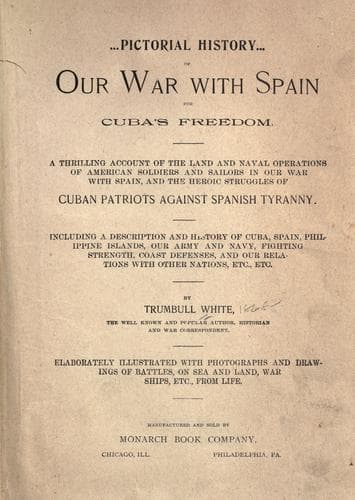
Our War with Spain for Cuba's FreedomWhite, Trumbull
History
Our War with Spain for Cuba's Freedom
White, Trumbull
Cuba -- History; Spain -- Foreign relations -- United States; Spanish-American War, 1898; United States -- Foreign relations -- Spain
The fire alarms in the bunkers were in working order, and there
had never been a case of spontaneous combustion of coal on board
the Maine. The two after boilers of the ship were in use at the
time of the disaster, but for auxiliary purposes only, with a
comparatively low pressure of steam and being tended by a reliable
watch. These boilers could not have caused the explosion of the
ship. The four forward boilers have since been found by the divers
and are in a fair condition.
On the night of the destruction of the Maine everything had been
reported secure for the night at eight P. M. by reliable persons,
through the proper authorities, to the commanding officer. At the
time the Maine was destroyed the ship was quiet, and, therefore,
least liable to accident caused by movements from those on board.
3. The destruction of the Maine occurred at 9:40 P. M. on the 15th
day of February, 1898, in the harbor of Havana, Cuba, she being at
the time moored to the same buoy to which she had been taken upon
her arrival.
There were two explosions of a distinctly different character,
with a very short but distinct interval between them, and the
forward part of the ship was lifted to a marked degree at the time
of the first explosion.
The first explosion was more in the nature of a report, like that
of a gun, while the second explosion was more open, prolonged and
of greater volume. This second explosion was, in the opinion of
the court, caused by the partial explosion of two or more of the
forward magazines of the Maine.
The evidence bearing upon this, being principally obtained from
divers, did not enable the court to form a definite conclusion as
to the condition of the wreck, although it was established that
the after part of the ship was practically intact and sank in that
condition a very few minutes after the destruction of the forward
part.
4. The following facts in regard to the forward part of the ship
are, however, established by the testimony: That portion of the
port side of the protective deck which extends from about frame 30
to about frame 41 was blown up aft, and over to port, the main
deck from about frame 30 to about frame 41 was blown up aft, and
slightly over to starboard, folding the forward part of the middle
superstructure over and on top of the after part.
This was, in the opinion of the court, caused by the partial
explosion of two or more of the forward magazines of the Maine.
Public-domain text, read in full here on John Shaqi.
Reviews
Reviews
No reviews yet
Be the first to share your thoughts on this work.
Elsewhere in the archive
Join the Discussion
Join the discussion
Sign in to leave a comment or review.
Sign InorCreate an account