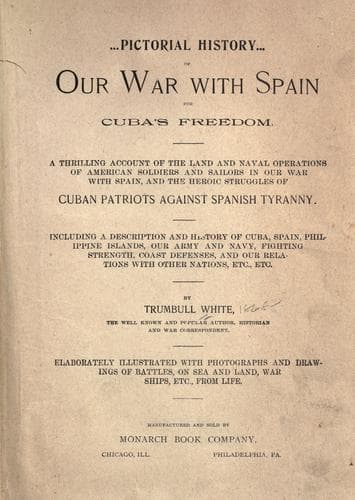
Our War with Spain for Cuba's FreedomWhite, Trumbull
History
Our War with Spain for Cuba's Freedom
White, Trumbull
Cuba -- History; Spain -- Foreign relations -- United States; Spanish-American War, 1898; United States -- Foreign relations -- Spain
5. At frame 17 the outer shell of the ship, from a point eleven
and one-half feet from the middle line of the ship and six feet
above the keel when in its normal position, has been forced up so
as to be now about four feet above the surface of the water,
therefore, about thirty-four feet above where it would be had the
ship sunk uninjured. The outside bottom plating is bent into a
reversed V-shape, the after wing of which, about fifteen feet
broad and thirty-two feet in length (from frame 17 to frame 25) is
doubled back upon itself against the continuation of the same
plating extending forward.
At frame 18 the vertical keel is broken in two and the flat keel
bent into an angle similar to the angle formed by the outside
bottom plating. This break is now about six feet below the surface
of the water and about thirty feet above its normal position.
THE OFFICERS OF THE MAINE EXONERATED.
In the opinion of the court this effect could have been produced
only by the explosion of a mine situated under the bottom of the
ship at about frame 18, and somewhat on the port side of the ship.
6. The court finds that the loss of the Maine on the occasion
named was not in any respect due to fault or negligence on the
part of the officers or men of the crew of said vessel.
7. In the opinion of the court the Maine was destroyed by the
explosion of a submarine mine, which caused the partial explosion
of two of her forward magazines.
8. The court has been unable to obtain evidence fixing the
responsibility for the destruction of the Maine upon any person or
persons.
W. T. SAMPSON, Captain U. S. N., President.
A. MARIX, Lieutenant-Commander U. S. N., Judge Advocate.
CHAPTER XXXV.
PATIENCE AT THE VANISHING POINT.
Our Former Troubles with Spain Recalled--The Verdict of the
People--Spanish Rule a Blot on Civilization--The Attitude of
Other Nations--The Necessity for Delay--The Message to Congress--
"The War in Cuba Must Stop!"
The American people did not wait for the report of the Naval
Board to form an opinion as to the cause of the tragedy. The
masses think in events, and not in syllogisms, and this was an
event. This event provoked suspicions in the public mind. The
thought of the whole nation was instantly directed to Cuba. The
fate of the sailors on the Virginius, twenty-five years ago, was
recalled. The public curiosity about everything Cuban and Spanish
became intense. The Weyler method of warfare became more generally
known. The story of our long diplomatic trouble with Spain was
recalled. Diplomacy was obliged to proceed with doors less
securely shut. The country watched for news from Washington and
from Madrid with eagerness. It happened to be a singularly quiet
and even dull time in our own political life--a time favorable for
the concentration of public attention on any subject that
prominently presented itself.
Leslie's Weekly voiced the popular sentiment in its issue of April
14 in the following language:
Public-domain text, read in full here on John Shaqi.
Reviews
Reviews
No reviews yet
Be the first to share your thoughts on this work.
Elsewhere in the archive
Join the Discussion
Join the discussion
Sign in to leave a comment or review.
Sign InorCreate an account