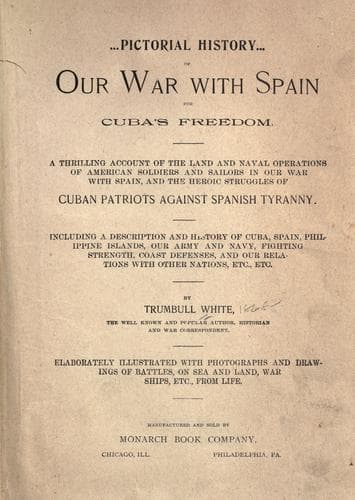
Our War with Spain for Cuba's FreedomWhite, Trumbull
History
Our War with Spain for Cuba's Freedom
White, Trumbull
Cuba -- History; Spain -- Foreign relations -- United States; Spanish-American War, 1898; United States -- Foreign relations -- Spain
Notwithstanding the fact that we were on the very verge of war,
with all its horrors, all its possibilities of destruction to life
and happiness, the nation pursued its accustomed way, transacted
its business by day, and slept peacefully at night. Upon the
shoulders of the Chief Executive rested the gravest of all
responsibilities, and the nation trusted to him to carry it
safely. Rash and impetuous demands for hasty and hostile action
were heard. Congressmen, under the pressure of their constituents,
filled the air with cries for speedy action, but amid all the
tumult the President stood serene. He realized, what the country,
strangely enough, had not comprehended, that we were drifting into
a conflict with a nation that was on a war footing. He knew that
we were totally unprepared for war. Munitions, ships, stores,
supplies, of vast amount and infinite variety, were absolutely
required before a step could be taken. Harbor defenses, a closer
connection between exposed points, and the installation of modern
armaments--a thousand things had to be done, and done at once.
Modern guns required supplies of modern ammunition, of which there
was scarcely any to be obtained on this side of the water. This
was the situation, as the President, the heads of the army and the
navy, and the Cabinet saw it, and it was left discreetly
undisclosed to the world.
They understood the necessity of delay as well as the necessity
for statesmanship of the highest quality in dealing with the Cuban
question. We lost nothing by their delay. We gained untold
advantages by their prudence, a prudence that never forsook them,
even when the preparations for war were completed. The message to
Congress was a calm, dispassionate, judicial presentation of the
case, and upon that presentation of facts and of evidence we went
before the jury of the nations of the world. There could be but
one verdict rendered that the American people could accept, and
that verdict, whether it came by peace or war, was, in the
language of the President's message, that "the war in Cuba must
stop!"
CHAPTER XXXVI.
EVENTS IN THE AMERICAN CONGRESS.
Cuba's Friends in Congress--Senator Proctor's Address to His
Colleagues--A Notable Exhibition of Patriotism--An Appropriation
for the National Defense--Relief for the Survivors and Victims of
the Maine--The Recognition of Cuban Independence.
From the date of the first attempt of the people of Cuba to
secure their independence from Spain, they have had advocates in
the American Congress who have worked with voice and vote in their
behalf. After the commencement of the revolution in 1895 these
champions gradually increased in numbers and influence, until at
the time of Mr. McKinley's inauguration they included in their
ranks many of the leaders in both houses.
Public-domain text, read in full here on John Shaqi.
Reviews
Reviews
No reviews yet
Be the first to share your thoughts on this work.
Elsewhere in the archive
Join the Discussion
Join the discussion
Sign in to leave a comment or review.
Sign InorCreate an account