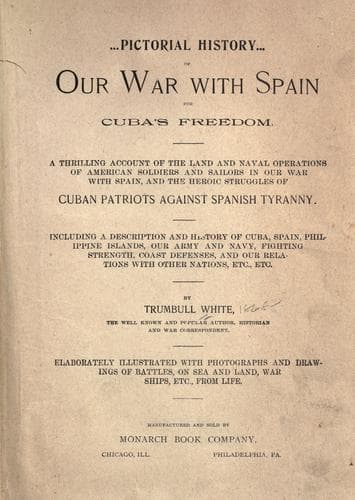
Our War with Spain for Cuba's FreedomWhite, Trumbull
History
Our War with Spain for Cuba's Freedom
White, Trumbull
Cuba -- History; Spain -- Foreign relations -- United States; Spanish-American War, 1898; United States -- Foreign relations -- Spain
In February, 1898, several Senators and Representatives went to
Cuba for the purpose of studying the conditions on the island, and
to gain a personal knowledge of the results of Spain's policy of
rule or ruin.
Senator Proctor was one of this committee, and after their return
to the United States, in a speech to his colleagues, he made the
strongest argument in favor of intervention in behalf of Cuba that
was ever made in the Senate of the United States. He had carefully
prepared his address, and he delivered it as an official report of
what he had observed on the island. He gave no opinion of what
action should be taken by the government. He said the settlement
"may well be left to an American President and the American
people." But while he did not make a recommendation in so many
words, he left the impression with all who heard him that he
favored a declaration by our government of the independence of
Cuba. He declared that he was opposed to annexation, and, while
many Cubans advocated the establishment of a protectorate by the
United States, he could not make up his mind that this would be
the best way out of the difficulty. He told his associates that he
believed the Cubans capable of governing themselves, and
reinforced this statement by the assertion that the Cuban
population would never be satisfied with any government under
Spanish rule. The senator's remarkable speech undoubtedly had a
powerful effect, both in influencing congressional action, and in
swaying public opinion. As an able and responsible member of
Congress and an ex-secretary of war, his words would carry weight
under any circumstances, but apart from these considerations, the
speech was notable because of its evident fidelity to facts, and
its restraint from everything resembling sensationalism.
A NOTABLE EXHIBITION OF PATRIOTISM.
There was never a more notable exhibiton of harmony and
patriotism in any legislative body in the world than occurred in
the House of Representatives when Congressman Cannon presented a
bill appropriating $50,000,000 for the national defense and
placing this amount in President McKinley's hands, to be expended
at his discretion.
Party lines were swept away, and with a unanimous voice Congress
voted its confidence in the administration. Many members who were
paired with absent colleagues took the responsibility of breaking
their pairs, an unprecedented thing in legislative annals, in
order that they might go on record in support of this vast
appropriation to maintain the dignity and honor of their country.
Speaker Reed, who as the presiding officer, seldom voted, except
in case of a tie, had his name called and voted in his capacity as
representative. The scene of enthusiasm which greeted the
announcement of the vote--yeas, 311; nays, none--has seldom been
paralleled in the House. The bill passed the Senate without a
dissenting vote, and, on March 9, the President signed the
measure, thus making it a law.
Public-domain text, read in full here on John Shaqi.
Reviews
Reviews
No reviews yet
Be the first to share your thoughts on this work.
Elsewhere in the archive
Join the Discussion
Join the discussion
Sign in to leave a comment or review.
Sign InorCreate an account