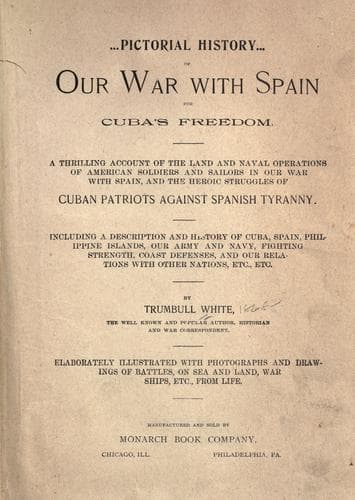
Our War with Spain for Cuba's FreedomWhite, Trumbull
History
Our War with Spain for Cuba's Freedom
White, Trumbull
Cuba -- History; Spain -- Foreign relations -- United States; Spanish-American War, 1898; United States -- Foreign relations -- Spain
Whereas, The abhorrent conditions which have existed for more than
three years in the island of Cuba, so near our own borders, have
shocked the moral sense of the people of the United States, have
been a disgrace to Christian civilization, culminating, as they
have, in the destruction of a United States battleship, with 260
of its officers and crew, while on a friendly visit in the harbor
of Havana, and cannot longer be endured, as has been set forth by
the President of the United States in his message to Congress of
April 11, 1898, upon which the action of Congress was invited;
therefore, be it resolved;
First--That the people of the island of Cuba are, and of right
ought to be, free and independent.
Second--That it is the duty of the United States to demand, and
the government of the United States does hereby demand, that the
government of Spain at once relinquish its authority and
government in the island of Cuba and Cuban waters.
Third--That the President of the United States be, and hereby is,
directed and empowered to use the entire land and naval forces of
the United States, and to call into the actual service of the
United States the militia of the several States to such an extent
as may be necessary to carry these resolutions into effect.
Fourth--That the United States hereby disclaims any disposition or
intention to exercise sovereignty, jurisdiction or control over
said island, except for the pacification thereof, and asserts its
determination when that is accomplished to leave the government
and control of the island to its people.
The Spanish government was deluded by the belief that in the event
of war our country would not be able to present a united front,
and that sectional animosities would weaken our strength. The
action of Congress from the time of the first rumors of war to the
end of the session snowed how little ground there was for this
belief. The representatives of the people from all sections of our
broad land gave President McKinley loyal support in every
undertaking, and the South vied with the North, the East with the
West, in expressions of devotion to our nation and our flag.
CHAPTER XXXVII.
PRESIDENT McKINLEY ACTS.
The Message to Congress--Loss of American Trade--Terrible
Increase in the Death Rate--American Aid for the Starving--The
President's Proposition to Spain--Grounds for Intervention--The
Destruction of the Maine--The Addenda.
With the press and public of the entire country at a fever heat
of indignation, and the evident determination on the part of a
large majority of the members of the Congress of the United States
to bring matters to a crisis, it was evident to all that the time
for action had arrived.
The President yielded to the popular demand, and on April 11 he
sent to Congress the following message:
To the Congress of the United States:
Public-domain text, read in full here on John Shaqi.
Reviews
Reviews
No reviews yet
Be the first to share your thoughts on this work.
Elsewhere in the archive
Join the Discussion
Join the discussion
Sign in to leave a comment or review.
Sign InorCreate an account