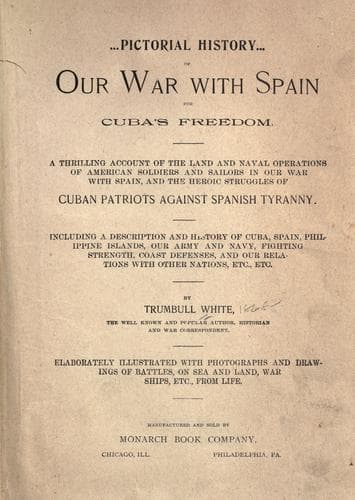
Our War with Spain for Cuba's FreedomWhite, Trumbull
History
Our War with Spain for Cuba's Freedom
White, Trumbull
Cuba -- History; Spain -- Foreign relations -- United States; Spanish-American War, 1898; United States -- Foreign relations -- Spain
RELIEF FOR THE SURVIVORS OF THE MAINE.
On March 21, the House unanimously passed the bill for the relief
of the survivors and victims of the Maine disaster. The bill
reimbursed the surviving officers and men for the losses they
sustained to an amount not to exceed a year's sea pay, and
directed the payment of a sum equal to a year's pay to the legal
heirs of those who perished.
When the President sent to Congress the report of the Naval Board
of Examiners the feeling of that body at once found open
expression in resolutions proposing a declaration of war,
recognition of the independence of Cuba, armed intervention, and
other decisive and warlike steps against Spain. Every group of
senators talked of Cuba. Constant and continual conferences were
held, and all recognized the seriousness of the occasion. On the
House side it was apparent that the majority could no longer be
controlled by what was known as the conservative element, led by
the speaker. Groups of members in a state of excitement were to be
seen on every hand. It was generally acknowledged that a serious
condition had arisen, that a crisis was at hand.
On April 11 the long expected message was received. In it the
President asked Congress to authorize him to take measures to
secure a termination of hostilities in Cuba, and to secure in the
island the establishment of a stable form of government, and to
use the military and naval forces of the United States as might be
necessary. The message was received in silence. The most notable
criticism made was the entire absence of any reference to Cuban
independence. The admission in the message that the President had
proposed an armistice to Spain until October provoked vigorous
comment. But conservative members were highly pleased with the
position taken by the President, and many still hoped that war
might be prevented.
However, this did not prevent the purchase of a number of armed
cruisers from foreign powers, which were transferred to the United
States flag. The ships of several passenger and mail lines were
also purchased, or leased as auxiliary cruisers, and were at once
remanned and put in commission. The most notable examples were the
two American built ships, St. Patil and St. Louis of the American
line. The new purchases were fitted for their new uses at once,
and the preparations for war went on without delay.
Congress, taking its cue from the President, united upon the
following resolutions which were signed by the President on April
20:
Joint resolutions for the recognition of the independence of the
people of Cuba demanding that the government of Spain relinquish
its authority and government in the island of Cuba, and to
withdraw its land and naval forces from Cuba and Cuban waters, and
directing the President of the United States to use the land and
naval forces of the United States to carry these resolutions into
effect.
Public-domain text, read in full here on John Shaqi.
Reviews
Reviews
No reviews yet
Be the first to share your thoughts on this work.
Elsewhere in the archive
Join the Discussion
Join the discussion
Sign in to leave a comment or review.
Sign InorCreate an account