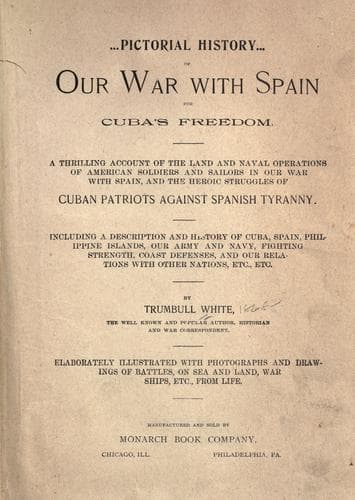
Our War with Spain for Cuba's FreedomWhite, Trumbull
History
Our War with Spain for Cuba's Freedom
White, Trumbull
Cuba -- History; Spain -- Foreign relations -- United States; Spanish-American War, 1898; United States -- Foreign relations -- Spain
Growth of the White Squadron in a Single Decade--Progress of Our
Navy a Gratifying Ode after It Was Fairly Started--How the United
States Stands in Comparison with the Other Nations of the World--
List of Ships in the American Navy--List of Ships in the Navy of
Spain at the Beginning of the War--Interest of All Countries
Centered on the Result of Our Naval Battles--Modern Guns and
Projectiles--The Armies of the Two Combatants--Coast Defenses of
the United States.
Three elements enter into the fighting efficiency of nations at
war: the strength of their navies, the strength of their armies
and the condition of their coast defences. For the first time in
many years general attention of the people of the United States
was centered upon these conditions when the outbreak of
hostilities began to threaten. Inasmuch as it was an admitted fact
that most of the fighting would be done at sea, or at least that
the efficiency of our fleets would be the most important factor,
most of the attention was directed to a study of the navy.
The constructions of what we call the new navy of the United
States, "the white squadron," which has placed us sixth in the
rank of the naval powers of the world, instead of so far down that
we were scarcely to be counted at all, has all been done in less
than twelve years. It may be that to stand sixth in rank is not
yet high enough, but the progress of a single decade certainly is
remarkable.
After the Civil War, when hostilities on our own coast and
complications abroad seemed to be at an end, the care of the navy
was abandoned and ships were sold with scarcely a protest, almost
as entirely as had been done eighty years before, at the end of
the Revolution. There was even less reason for this policy,
because in 1785 the country was poor and needed the money the
ships brought, while in the twenty years following the Civil War
there was no such excuse of national poverty. By 1885 there was no
United States navy at all worthy the name, for the wooden vessels
on the list, with their obsolete guns, were of no value whatever
in the event of hostilities with a foreign power that had kept up
its equipment with rifled guns and ironclads.
The movement to repair the decay began when, in 1881, Secretary of
the Navy William H. Hunt appointed the first advisory board,
presided over by Rear-Admiral John Bodgers, "to determine the
requirements of a new navy." This board reported that the United
States should have twenty-one battleships, seventy unarmored
cruisers of various sizes and types, twenty torpedo boats, five
rams and five torpedo gunboats, all to be built of steel. The
report was received by Congress and the country with the attention
it merited, but to get the work started was another matter.
POLICY OF THE ECONOMISTS.
Public-domain text, read in full here on John Shaqi.
Reviews
Reviews
No reviews yet
Be the first to share your thoughts on this work.
Elsewhere in the archive
Join the Discussion
Join the discussion
Sign in to leave a comment or review.
Sign InorCreate an account