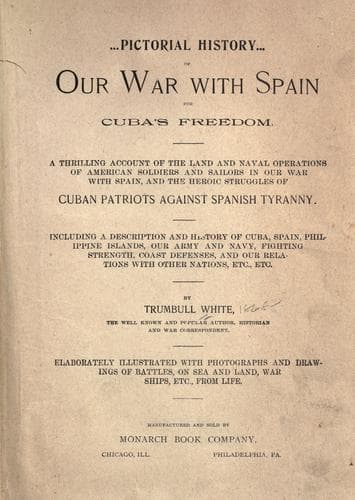
Our War with Spain for Cuba's FreedomWhite, Trumbull
History
Our War with Spain for Cuba's Freedom
White, Trumbull
Cuba -- History; Spain -- Foreign relations -- United States; Spanish-American War, 1898; United States -- Foreign relations -- Spain
The economists had been praising the policy of idleness in naval
construction, claiming first that we were at peace and did not
need to spend money on expensive vessels and, next, that naval
construction was in an experimental stage and that we should let
the European nations go to the expense of the experiments, as they
were doing, and when some result had been reached, take advantage
of it, instead of wasting our own money in work that would have to
be thrown away in a few years.
When the country became convinced that a navy was needed, it was
found that we could not follow out that pleasant little theory.
Our naval authorities could not obtain the facts and the
experience they wanted from other nations, and our shipyards could
not build even one of the armored ships. We could not roll even
the thinnest of modern armor-plates, and could not make a gun that
was worth mounting on a modern vessel if we had it.
The shipyard of John Roach did the first work on the new navy, and
during Secretary Chandler's term of office built the Chicago, the
Boston, the Atlanta and the Dolphin. Instead of battleships, the
first of the fleet were third-rate cruisers. Armor-plate was
bought in a foreign market, and we actually went abroad for the
plans of one our largest cruisers--the Charleston.
In 1885 the navy department came under the administration of
Secretary William C. Whitney, and it was beginning with his years
of service that the greatest progress was made. While our
shipyards were learning to build ships, the gunmakers and the
makers of armor-plate were learning their craft too, so that
progress was along parallel lines. In 1886 the sum of $2,128,000
was appropriated for modern rifled guns. The first contract for
armor-plate was signed in 1887. Since that time the plants for
construction have been completed and armor-plate equal to the best
in the world turned out from them. Ten years of apprenticeship
have taught us how to build whatever we need to carry on naval
warfare.
TAKES THE RANK OF SIXTH.
By 1894 the United States had risen to the sixth among the naval
powers of the world, the first ten and their relative strength
expressed in percentage of that of Great Britain being as follows:
Great Britain 100 United States 17
France 68 Spain 11
Italy 48 China 6
Russia 38 Austria 5
Germany 21 Turkey 3
Public-domain text, read in full here on John Shaqi.
Reviews
Reviews
No reviews yet
Be the first to share your thoughts on this work.
Elsewhere in the archive
Join the Discussion
Join the discussion
Sign in to leave a comment or review.
Sign InorCreate an account