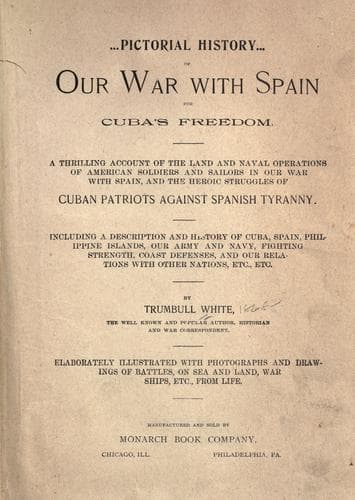
Our War with Spain for Cuba's FreedomWhite, Trumbull
History
Our War with Spain for Cuba's Freedom
White, Trumbull
Cuba -- History; Spain -- Foreign relations -- United States; Spanish-American War, 1898; United States -- Foreign relations -- Spain
Magellanes 6,932 0 17.0 Steel
Buenos Aires 5,195 0 14.0 Steel
Montevideo 5,096 0 14.5 Steel
Alfonso XII 5,063 0 15.0 Steel
Leon XIII 4,687 0 15.0 Steel
Satrustegui 4,638 0 15.0 Steel
Alfonso XIII 4,381 0 16.0 Steel
Maria Cristina 4,381 0 16.0 Steel
Luzon 4,252 0 13.0 Steel
Mindanao 4,195 0 13.5 Steel
Isla de Panay 3,636 0 13.5 Steel
Cataluna 3,488 0 14.0 Steel
City of Cadiz 3,084 0 13.5 Steel
INTEREST IN THE WORKING OF MODERN WAR SHIPS.
The puzzle that was troubling every naval authority as well as
every statesman in the civilized world, at the outbreak of the war
between the United States and Spain, was what would be the results
of a conflict at sea between the floating fortresses which now
serve as battle-ships. Since navies reached their modern form
there had been no war in which the test of the battle-ship was
complete. Lessons might be learned and opinions formed and
prophesies made from the action of battle-ships in the war between
China and Japan, the war between Chili and Peru, and from the
disasters which had overtaken the Maine in the harbor of Havana
and the Victoria in her collision with the Camperdown, as well as
the wreck of the Reina Regente and others. But in all these,
combine the information as one might, there was insufficient
testimony to prove what would happen if two powers of nearly equal
strength were to meet for a fight to a finish.
Whatever was uncertain, it was known at least that there would be no
more sea fights like those of the last century and the first half of
this, when three-deck frigates and seventy-four-gun men-of-war were
lashed together, while their crews fought with small arms and cutlasses
for hours. Those were the days when "hearts of oak" and "the wooden
walls of England" made what romance there was in naval warfare, and the
ships of the young United States won respect on every sea. In the fights
of those days the vessels would float till they were shot to pieces, and
with the stimulus of close fighting the men were ready to brave any odds
in boarding an enemy's craft. It was well understood that the changed
conditions would make very different battles between the fighting
machines of to-day.
Public-domain text, read in full here on John Shaqi.
Reviews
Reviews
No reviews yet
Be the first to share your thoughts on this work.
Elsewhere in the archive
Join the Discussion
Join the discussion
Sign in to leave a comment or review.
Sign InorCreate an account