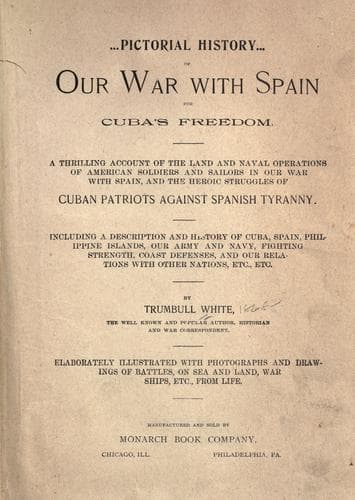
Our War with Spain for Cuba's FreedomWhite, Trumbull
History
Our War with Spain for Cuba's Freedom
White, Trumbull
Cuba -- History; Spain -- Foreign relations -- United States; Spanish-American War, 1898; United States -- Foreign relations -- Spain
That a naval battle between modern fleets, armed with modern guns,
would be a terribly destructive one both to the ships and to the
lives of those who manned them, was conceded by all naval
authorities. The destructiveness would come not only from the
tremendous power and effectiveness of the guns, but also from the
fact that the shell had replaced the solid shot in all calibers
down to the one-pounder, so that to the penetrating effect of the
projectile was added its explosive power and the scattering of its
fragments in a destructive and death-dealing circle many feet in
diameter.
MODERN GUNS AND PROJECTILES.
The modern armor-piercing shell, made of hardened steel, and with
its conical point carefully fashioned for the greatest penetrating
power, has all the armor-piercing effectiveness of a solid shot of
the same shape, while its explosiveness makes it infinitely more
destructive. For the modern shell does not explode when it first
strikes the side or armor of an enemy's ship, but after it has
pierced the side or armor and has exhausted its penetrative
effect. The percussion fuse is in the base of the shell, and is
exploded by a plunger driven against it by the force of the impact
of the shell on striking. The time between the impact of the shell
and its explosion is sufficient for it to have done its full
penetrative work.
It first must be understood that all modern guns on ships-of-war are
breech-loading and rifled, and that the smooth bore exists only as a
relic, or to be brought out in an emergency for coast defense, when
modern guns are not available. From the thirteen-inch down to the
four-inch, the guns are designated by their caliber, the diameter of
their bore, and the shot they throw, while from that to the one-pounder
they take their name from the weight of the shot. Everything below the
one-pounder is in the machine-gun class.
The base of rapid-fire work is the bringing together in one
cartridge of the primer, powder, and shell. When the limit of
weight of cartridge, easily handled by one man, is reached, the
limit of rapid-fire action is also reached; and, although the
quick-moving breech mechanisms have been applied abroad to guns of
as large as eight-inch caliber, such guns would rank as quick,
rather than rapid firing, and would require powder and shot to be
loaded separately.
Public-domain text, read in full here on John Shaqi.
Reviews
Reviews
No reviews yet
Be the first to share your thoughts on this work.
Elsewhere in the archive
Join the Discussion
Join the discussion
Sign in to leave a comment or review.
Sign InorCreate an account