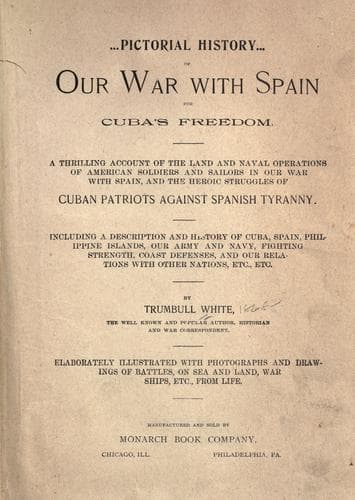
Our War with Spain for Cuba's FreedomWhite, Trumbull
History
Our War with Spain for Cuba's Freedom
White, Trumbull
Cuba -- History; Spain -- Foreign relations -- United States; Spanish-American War, 1898; United States -- Foreign relations -- Spain
To attain its extreme range a gun must be given an elevation of about
fifteen degrees. The greatest elevation given any of the guns on
shipboard is about six degrees. This limit is made by two factors--the
size of the portholes or opening in the turrets for the larger guns, and
the danger of driving the gun backward and downward through the deck by
any greater elevation. The practical range of the great guns of a ship,
the ten, twelve, and thirteen-inch, is not, therefore, believed to be
over five or six miles, and even at that range the chances of hitting a
given object would be very small. A city could, of course, be bombarded
with, effect at such a range, since a shell would do tremendous damage
wherever it might strike, but a city to which a ship could approach no
nearer than say seven miles would be safe from bombardment.
The muzzle velocities given the shells from the guns of the navy are
something tremendous, while the muzzle energy is simply appalling. The
shell from the thirteen-inch gun leaves the muzzle at a velocity of
2,100 feet a second, and with an energy of 33,627-foot tons, or the
power required to lift one ton one foot. From this velocity the range is
to 1,800 feet a second in the one-pounder, although from the
three-pounder at 2,050 feet it averages about the same as the
thirteen-inch. The five-inch rapid-fire gun has the greatest muzzle
velocity at 2,250 feet. The muzzle energy is, of course, small in the
smaller guns, being only twenty-five-foot tons in the one-pounder and
500 tons in the fourteen-pounder.
The power of penetration has already been given in a general way,
but the power of penetration of steel is much greater. At its
muzzle velocity the thirteen-inch shell will penetrate 26.66
inches of steel, the twelve-inch, 24.16 inches; the ten-inch, 20
inches, and the five-inch, 9 inches. The one-pound shell bursts in
piercing one-fourth and nine-sixteenths-inch plates, scattering
its fragments behind the target.
It may be interesting to note that the cost of one discharge of a
thirteen-inch gun is $800, and that when a battleship like the
Massachusetts lets loose her entire battery, both main and
secondary, the cost of a single discharge is $6,000.
CHAPTER XXXIX.
BATTLESHIPS AND TROOPS BEGIN TO MOVE.
The North Atlantic Squadron Sent to Key West--Commodore Schley at
Hampton Roads--The Voyage of the Oregon--The Camp at Chickamauga--
Where the Initial Work of Mobilizing the Troops Was Done--Life at
Camp Thomas--Life on the Famous Battle Field--Rendezvous at Fort
Tampa--The Great Artillery Camp.
Public-domain text, read in full here on John Shaqi.
Reviews
Reviews
No reviews yet
Be the first to share your thoughts on this work.
Elsewhere in the archive
Join the Discussion
Join the discussion
Sign in to leave a comment or review.
Sign InorCreate an account