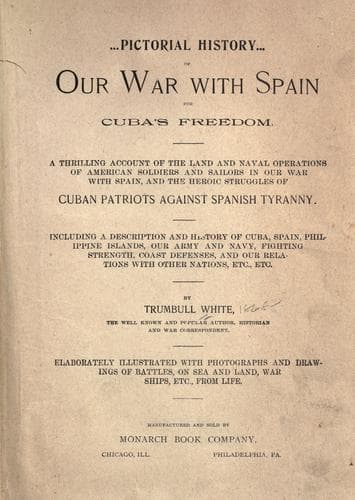
Our War with Spain for Cuba's FreedomWhite, Trumbull
History
Our War with Spain for Cuba's Freedom
White, Trumbull
Cuba -- History; Spain -- Foreign relations -- United States; Spanish-American War, 1898; United States -- Foreign relations -- Spain
Immediately following the action of Congress authorizing the
President to call into service the army and navy of the United
States, the North Atlantic squadron, under command of Captain
Sampson, was mobilized at Key West. It consisted of the following
vessels: Battleships Iowa and Indiana, armored cruiser New York,
the monitors Puritan, Terror and Amphitrite, the gunboats
Nashville, Castine, Machias, Wilmington and Helena, the cruisers
Detroit, Cincinnati and Marblehead, and the torpedo-boats Cushing,
Ericsson, Dupont, Foote, Winslow, Porter and Mayflower.
These comprised a hard fighting aggregation under a cool and
daring fighter. The two first-class battleships were not equaled
in fighting power by anything in the Spanish navy, and the New
York was one of the best fighting ships of her kind in the world.
Commodore Winfield Scott Schley and the fighters of his flying
squadron were gathered at Hampton Roads, impatient for orders from
Washington to face the foe. Far away in Pacific waters Commodore
Dewey was cabled the command to hold himself in readiness to
proceed to Manila, and the good ship Oregon, under command of
Captain Clarke, was steaming her way around Cape Horn to join the
fleet in Cuban waters.
In the army equal activity was shown.
THE CAMP AT CHICKAMAUGA.
Chickamauga Park, near Chattanooga, Tenn., was the point of
concentration for the regular troops which were gathered for the
war with Spain. It was the initial camp where the mobilization
took place, and from which soldiers and supplies were dispatched
to seacoast towns within easy striking distance of Cuba. When
orders went out from army headquarters at Washington for the
movement of the regulars to Chickamauga a thrill of soldierly
pride swelled the breast of every man who wore Uncle Sam's blue
uniform, and there was a hasty dash for the new camp. There is
nothing an army man, officer or private, dislikes so much as
inactivity. Fighting, especially against a foreign foe, suits him
better than dawdling away his time in idleness, and word to "get
to the front" is always welcome.
Public-domain text, read in full here on John Shaqi.
Reviews
Reviews
No reviews yet
Be the first to share your thoughts on this work.
Elsewhere in the archive
Join the Discussion
Join the discussion
Sign in to leave a comment or review.
Sign InorCreate an account