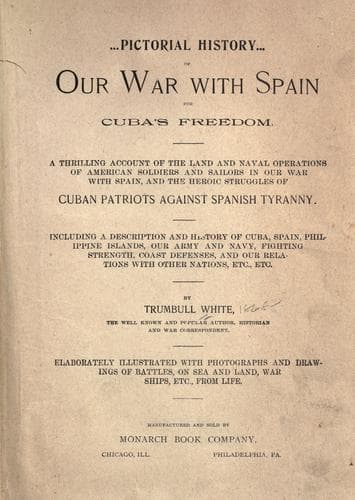
Our War with Spain for Cuba's FreedomWhite, Trumbull
History
Our War with Spain for Cuba's Freedom
White, Trumbull
Cuba -- History; Spain -- Foreign relations -- United States; Spanish-American War, 1898; United States -- Foreign relations -- Spain
Anticipating the action taken by Congress, a peculiar form of
notice had been agreed upon between Consul-General Lee and the
Consuls some weeks previously. The telegram notifying them to
leave the island was to be in these words: "Appropriation for
relief of American citizens is exhausted." This form was devised
for a reason which had its bearing upon the unhappy fate of the
Americans left on the island. Spaniards of the vindictive class
never got over the action of the United States in undertaking the
support of its citizens in Cuba. That action was in striking
contrast "with the course of the Spanish Government. The Spaniards
lost no opportunity to show their resentment toward the Americans.
When local measures of relief were planned, the Americans were
taunted, and told to look to the United States for help and
protection. The charity extended by the United States brought upon
the beneficiaries persecution at the hands of the Spaniards.
General Lee, realizing the strength of this unworthy sentiment,
thought that a message in the language quoted would be so grateful
to Spanish eyes that it would be put through to the Consuls
without delay. He was right about that. The government attempted
to make provision for the removal of the Americans on the island
at the same time that the Consuls were notified to withdraw.
Results showed that only a comparatively small number availed
themselves of the opportunities to go. A ship made its way along
the south coast of Cuba and removed from Santiago, Manzanillo and
Cienfuegos between 200 and 300 refugees, conveying them to
Jamaica. This was hardly one-half. From the northern coast the
number taken off the island was much smaller. At Havana there were
on the rolls of the Consulate over 600 Americans, of whom perhaps
200 elected to take passage on the ships sent by the United
States. At Matanzas, Consul Brice had about 400 Americans. Consul
Barker, at Sagua, had about the same number, while Consul Hance,
at Cardenas, had about 100. Very few of these wanted to leave
their interests and relatives. All of them were utterly destitute.
They did not know what they could do if they landed in the United
States without friends. Many of them were Cubans, who had lived in
the United States only long enough to obtain American citizenship.
All their ties were in Cuba. They believed that the warships would
come quickly with provisions. And so they chose to stay. When the
Consuls left they put food enough in the possession of these
Americans to last them from ten days to two weeks. The fate of
these unfortunates can only be imagined. From the prejudice which
existed toward the American reconcentrados the Consuls know that
they would be the last to receive any consideration when the
blockade began to bear heavily.
SPANISH SPIES AT WORK.
Public-domain text, read in full here on John Shaqi.
Reviews
Reviews
No reviews yet
Be the first to share your thoughts on this work.
Elsewhere in the archive
Join the Discussion
Join the discussion
Sign in to leave a comment or review.
Sign InorCreate an account