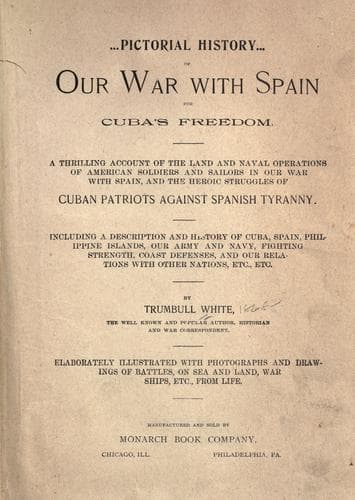
Our War with Spain for Cuba's FreedomWhite, Trumbull
History
Our War with Spain for Cuba's Freedom
White, Trumbull
Cuba -- History; Spain -- Foreign relations -- United States; Spanish-American War, 1898; United States -- Foreign relations -- Spain
Just prior to the breaking out of actual hostilities between this
country and Spain the military attache of the Spanish legation at
Washington was compelled to leave this country, because it was
known he had been seeking to learn certain facts relative to the
strength of our forts and their defensive equipment. This man was
Lieutenant Sobral, and in plain and uncompromising English, he was
a spy, or member of the Spanish secret service, which implies the
same thing.
Before he left this country he had been ejected from several forts
along the South Atlantic coast, where he had been found
endeavoring to gain access to those mysteries which no man, unless
he wears the blue of the United States army, can righteously know
aught of, even in times of peace. This was the first intimation
this country had that Spain would introduce here the same system
of espionage she employs at home. Following Sobrap's expulsion
from the country came the knowledge that Spanish spies were
working in Washington, watching every move made there; that they
swarmed in Key West and in New York city, where they maintained a
strict surveillance over the members of the Cuban Junta.
Many of these spies were American citizens, or at least nominally
so, for their work was done under the direction of a well-known
detective agency, acting, of course, with the Spanish
representatives here. These men were principally engaged in
preventing the shipment of stores and arms to Cuba. At one time it
was impossible to enter or leave the building where the Junta had
its headquarters without observing one or more men hanging about
the place, apparently with nothing to do and making a vain effort
to do it as gracefully as possible. These were thrilling times in
the annals of the Junta, when Rubens, Palma and Captain O'Brien
were regularly followed to and from their homes to their
headquarters. These were good times, too, for the American
detective agency. But all this was mere clumsy work, more of an
annoyance than anything else, and scarcely any hindrance to the
shipping of arms and stores when the Junta was fortunate enough to
have the arms and stores to ship.
But after the declaration of war, the spy question assumed an
aspect as serious as it was unlocked for. Spain worked silently,
secretly and through one of the best-handled branches of her
government and with all the Latins' natural love of intrigue. She
no longer paid much heed to Palma or Rubens, or to Captain
O'Brien. She was playing a bigger game. American detectives no
longer represented her interests here--an impossibility under
existing conditions, of course. Under Polo was established a most
complete department of espionage, which he controlled from the
refuge Canada offered him.
Public-domain text, read in full here on John Shaqi.
Reviews
Reviews
No reviews yet
Be the first to share your thoughts on this work.
Elsewhere in the archive
Join the Discussion
Join the discussion
Sign in to leave a comment or review.
Sign InorCreate an account