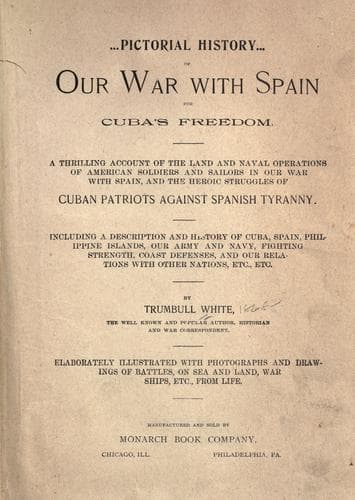
Our War with Spain for Cuba's FreedomWhite, Trumbull
History
Our War with Spain for Cuba's Freedom
White, Trumbull
Cuba -- History; Spain -- Foreign relations -- United States; Spanish-American War, 1898; United States -- Foreign relations -- Spain
The gathering together of information and those facts which
usually concern the operation of secret service of civilized
countries seemed to be a side issue with this particular
department. The scope of its operations was along different lines
from those usually followed by the mere spy.
Polo's intention appeared to be to carry the war into America in a
new and startling manner--startling, because his movements could
not be seen or foretold until the blow was struck. He made use of
the corps under his control to place the bomb of the anarchist and
apply the torch of the incendiary under our arsenals and to those
buildings where the government stored its supplies for the army
and navy.
For a time he was successful in his cowardly scheming and his
emissaries celebrated his success with many tons of good American
gunpowder, and at the cost of some good American lives. Bombs were
found in the coal reserved for use aboard our men-of-war. They
were even taken from the coal bunkers of our ships and they were
found in certain of the government buildings at Washington.
Indeed, the situation became so serious that finally strangers
were not allowed to visit a man-of-war or enter a fort.
It must be remembered that there are in America thousands of
Spaniards who, unless they commit some overt act of violence, can
enjoy all the privileges accorded to a citizen. This, together
with our mixed population, in many quarters made up largely of the
peoples of Southern Europe, all more or less of one type, all
speaking languages which, to untrained ears at least, are almost
identical one with the other, gave the Spanish spy in America a
protection and freedom from suspicion and surveillance he would
hardly meet with in any other country, and which, by the inverse,
offered no opportunity for the American spy in Spain, had we
chosen to make use of the same methods.
PLAYING A DESPERATE GAME.
These Spaniards were playing a desperate game, however. It was
literally at the peril of their necks, for should a man be
apprehended, there would be no possibility of escaping the
ignominious death that usually awaits on such services. Sobral was
allowed to go, though there was no question but that his conduct
was so incriminating that he was liable to arrest, trial, and, if
convicted, death, had this country cared to hold him. His fate
abroad would be easy to foretell. His guilt was almost as great as
that which brought Major Andre to his death in the times of the
Revolution.
CHAPTER XLI.
FIRST GUNS AND FIRST PRIZES OF THE WAR.
Capture of the LaFayette--The Government Orders Her Release--
Towing Prizes Into Key West--The Spanish Set a Trap--The Vicksburg
and the Morrill Take the Bait--The Spanish Gunners Poor Marksmen--
Another Narrow Escape.
Shortly after the proclamation of the blockade of Cuban ports a
capture was made which threatened international complications. The
French mail steamer LaFayette was held up almost under the guns of
Morro Castle.
Public-domain text, read in full here on John Shaqi.
Reviews
Reviews
No reviews yet
Be the first to share your thoughts on this work.
Elsewhere in the archive
Join the Discussion
Join the discussion
Sign in to leave a comment or review.
Sign InorCreate an account