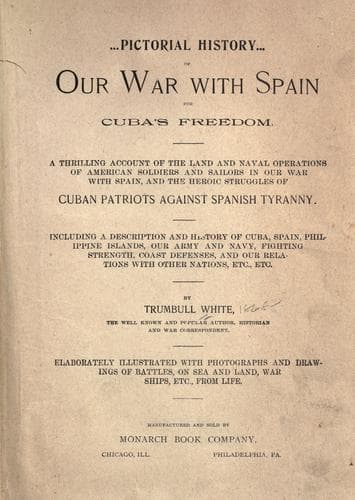
Our War with Spain for Cuba's FreedomWhite, Trumbull
History
Our War with Spain for Cuba's Freedom
White, Trumbull
Cuba -- History; Spain -- Foreign relations -- United States; Spanish-American War, 1898; United States -- Foreign relations -- Spain
While the United States was not a party to the Declaration of
Paris, the government made known its intention to maintain its
four cardinal principles: (1) Privateering abolished. (2) Neutral
flags to exempt an enemy's goods from capture, except contraband
of war. (3) Neutral goods under an enemy's flag not to be seized
(4) Blockade to be binding must be effective. Spain, on her part,
issued a decree recognizing the fact that a state of war existed,
breaking off all treaties with the United States, and promising to
observe the rules just given, except that she maintained her right
to grant letters of marque to privateers. But this exception was
modified by Spain's declaring her intention to send out only
auxiliary cruisers taken from the mercantile marine and kept under
naval control. One consideration which may have influenced this
decision was the self-evident fact that the European Powers would
certainly interfere, in the event that Spain attempted to carry on
privateering under the old methods.
THE WAR FEELING IN SPAIN.
In Spain the war feeling was high. The Queen Regent, in her
speech to the Cortes, declared "the unalterable resolution of my
government to defend our rights, whatsoever sacrifices may be
imposed upon us in accomplishing this task." She said further:
"Thus identifying myself with the nation, I not only fulfil the
oath I swore in accepting the regency, but I follow the dictates
of a mother's heart, trusting to the Spanish people to gather
behind my son's throne and to defend it until he is old enough to
defend it himself, as well as trusting to the Spanish people to
defend the honor and territory of the nation."
THE POLICY OF THE ADMINISTRATION.
The President and Congress undoubtedly acted on the lines of good
policy in making a formal declaration of war. As Mr. McKinley said
in his message to Congress, the trend of events compelled him to
take measures of a hostile kind. A blockade had been established
and Spanish vessels had been captured. While every civilized power
on earth immediately learned the facts, there still remained the
necessity of going through the formal act of notifying them of
this government's intentions. In this instance, as in others in
the nation's history, the actual hostilities were begun before it
seemed necessary for the government to make a formal declaration.
According to the authorities on international law, "a declaration
may be necessary, but is not essential." In this case, when it
became so evident that a general conflict was imminent, the
administration did fairly by the commercial nations of the world
in formally stating its position, and giving them all warning as
to the consequences which might follow in the case of vessels
attempting to enter Cuban waters.
The resolutions were admirably brief and concise, merely declaring
the existence of a state of war, and authorizing the President to
do whatever he thought best with the army and the navy.
Public-domain text, read in full here on John Shaqi.
Reviews
Reviews
No reviews yet
Be the first to share your thoughts on this work.
Elsewhere in the archive
Join the Discussion
Join the discussion
Sign in to leave a comment or review.
Sign InorCreate an account