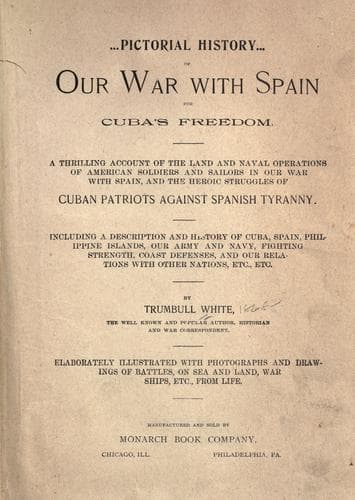
Our War with Spain for Cuba's FreedomWhite, Trumbull
History
Our War with Spain for Cuba's Freedom
White, Trumbull
Cuba -- History; Spain -- Foreign relations -- United States; Spanish-American War, 1898; United States -- Foreign relations -- Spain
By this act, while the situation was in itself no way changed, the
nation assumed a definite diplomatic status as a power at war, and
was free to proceed to any such acts as came within the laws of
civilized nations in time of war.
EFFECT OF THE DECLARATION IN CUBA.
When the news of the action of the administration reached the
insurgents in Cuba it caused great rejoicing among them, for they
felt that the hour of their deliverance was at last at hand. In
speaking of it, Dr. Capote, Vice-President of the Cuban Republic,
said:
I desire to thank the great American people and their government
for the resolution they have made to free us from the tyrannical
rule of Spain. The people of Cuba believe in the good faith of the
people of America. They believe in their honesty of purpose to
free Cuba and are confident of their ability to do so; but it must
be borne in mind that the loadstar of the Cuban is not merely
freedom from the dominion of Spain, but independence from outside
control, however beneficent that control might be, and absolute
non-interference by others in the management of our own affairs.
"Cuba free and independent" is the watchword of Cuban liberty.
The Cuban commanders await some decisive step on the part of your
generals. If you can open up and maintain communication with the
Cuban armies, and give us a plentiful supply of arms and
ammunition, we will free Cuba without the loss of an American
soldier. Our position on the field is precarious. For lack of
supplies, we cannot concentrate our troops. Our camps shift from
place to place, according to food conditions. We are hampered and
embarrassed for lack of ammunition. We cannot arm the men we are
able to put in the field. Open up communication, give us arms and
supplies, and we ask no more.
As to the eventual settlement of the island, when the war is ended
and when the last Spanish soldier has left Cuba, the work of the
provisional government will be ended. The people of Cuba, whatever
the class or sympathy, will then say how we shall be governed.
There will be no reprisals, no confiscation, no distinctions.
CHAPTER XLIII.
CALL FOR THE NATIONAL GUARD, OUR CITIZEN SOLDIER.
Enthusiastic Answer to the Call--Requirements of the War
Department--Who May Enlist--How the Army was Formed--In the
Training Camps--The American Makes the Best Soldier--The "Rough
Riders"--Cowboys and Society Men--Their Uniforms and Their
Weapons--Their Fighting Leaders.
If all the men who showed a desire to answer the call to arms had
been accepted, no nation in the world could have boasted of a
larger army. The demand was so limited and the supply so great
that many more had to be refused than were accepted, and many of
the National Guard, who were given the preference in all the
States, were rejected at the final examination, because they
lacked some of the qualifications necessary in a soldier of the
United States.
Public-domain text, read in full here on John Shaqi.
Reviews
Reviews
No reviews yet
Be the first to share your thoughts on this work.
Elsewhere in the archive
Join the Discussion
Join the discussion
Sign in to leave a comment or review.
Sign InorCreate an account