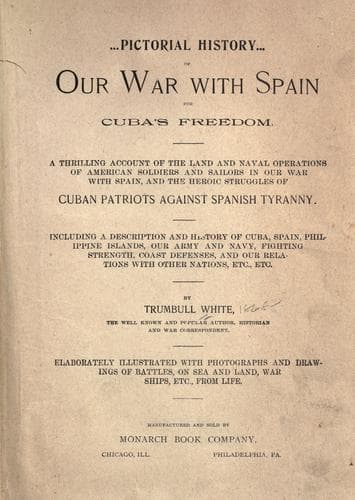
Our War with Spain for Cuba's FreedomWhite, Trumbull
History
Our War with Spain for Cuba's Freedom
White, Trumbull
Cuba -- History; Spain -- Foreign relations -- United States; Spanish-American War, 1898; United States -- Foreign relations -- Spain
But after all organic centers have been found in excellent
condition several things yet remain to be tested. A man's feet
must not blister easily. His teeth must be good, because bad teeth
interfere with digestion and are apt to develop stomach troubles.
Of course other things taken into consideration a particular
defect may be overlooked according to the discretion of the
doctor. A man with his index finger gone stands no show.
A bow-legged man will be accepted, but a knocked-kneed man rarely.
The final test is of the eyes. At a, distance of twenty feet one
must be able to read letters a half inch in size. Many tricks were
played to read the letters when the eager candidate could see only
a blur before him. The favorite method was to memorize the letters
from those who had taken the examination and knew in just what
order the letters were situated.
HOW AN ARMY IS FORMED.
The making of an army--that is what it means to turn men of peace
to men of war, to fit the mechanic or the business man, the farmer
or the miner, for a passage at arms with a foreign foe--has been
for the present generation a matter of conjecture and of lessons
drawn from previous passages in the nation's chronicles. In our
war with Spain it became a fact, and the progress made in the
various stages forms a chapter in the public history which is as
interesting as any of those conquests of either peace or war which
brighten for every American the pages of the achievements of the
Union of the States.
It is impossible to tell just how an army is made. During the long
debates which preceded the declaration of war, eloquent men on
both sides of the chambers of Congress pictured the strength of
American arms, the shrillness of the scream of the eagle, and the
sharpness of his talons, and applauding galleries saw in the
coming combat little but the calling out of the vast body of the
reserve strength of the American people, its marching upon the
enemy, and return, bearing captured standards and leading
prisoners in chains, to the music of the applauding nations, and
the thanksgiving of a people made free by their struggles. The
other side was never touched. The nights of toil by staff
officers, the multiplied forces of mills and factories, the shriek
of the trains crossing the continent, bearing men and munitions,
and the hours of waiting for the completion of those warlike
implements which the peaceful American has never before
contemplated in the expansion of his industrial institutions, were
entirely overlooked.
Not by all, however, for, from the moment the conflict seemed
inevitable, stern-eyed men who had fought before began to count,
not the cost, but the hours between the giving of an order and its
fulfillment, between the calling and the coming, and finally when
the results of their labors were completed the story of what they
did may be partly told.
Public-domain text, read in full here on John Shaqi.
Reviews
Reviews
No reviews yet
Be the first to share your thoughts on this work.
Elsewhere in the archive
Join the Discussion
Join the discussion
Sign in to leave a comment or review.
Sign InorCreate an account