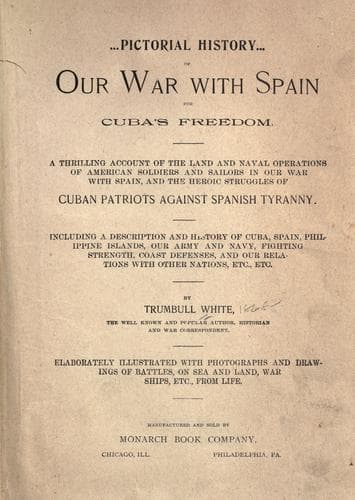
Our War with Spain for Cuba's FreedomWhite, Trumbull
History
Our War with Spain for Cuba's Freedom
White, Trumbull
Cuba -- History; Spain -- Foreign relations -- United States; Spanish-American War, 1898; United States -- Foreign relations -- Spain
All the processes of making a soldier are as distinct as are those
which mark the seed time and the harvest, the milling and the
making of the loaf. It can be readily seen that in a country where
the standing army is but 25,000, and the militia forces of the
various States bears such a slight proportion to the population,
that manufactures of materials of use only in time of war could
not flourish. Thus it was that at the time of the commencement of
hostilities there was available in the United States equipment for
an army of less than one-fifth the size of that which afterwards
took the field, and patriotism and fidelity were shown as much in
the outfitting of that force, as can be shown in actual battle by
any volunteer or regular officer, whether he be posted in fort or
field, and win glory by brilliant dash, or simply doing his duty
by holding his post.
The ready response to the President's call for volunteers was
sufficient to prove that the people were eager to take up arms and
ready to go to the front. But enthusiasm, patriotism and readiness
never make an army. An army is a great machine, of which each
individual is a part, and there even the militia men of the
various States, who had spent so much time in preparing themselves
for just such a struggle, lacked the one great element without
which no army can hope for success: the capacity to move in
unison. Few of the States had given their men the training which
makes of the simple company or regiment a wheel in the brigade or
division.
In the great camps at Chickamauga, at Camp Alger, at Tampa, and at
San Francisco the task of making an army from men who a month
before had been working in the store, the mill or the field, went
on. This meant long, thorough drilling under competent
instructors. Careful study of the tactics and intelligent
comprehension of the meaning of an order makes the soldier. It is
not possible to imagine anything more difficult than the thorough
training of the arms bearer, and for this task the American seems
better fitted than the men of any other country. In an analysis of
the soldiers of the world an authority would place the American,
combining as he does the blood of nations, at the head of the
list, for the reason that with his finer sensibility, his greater
capacity to think while acting and to act while thinking, all tend
to produce in him that character capable of high and perfect
development in the soldier.
At Chickamauga, under General Wade; at Washington, under General
Graham; at Tampa, under General Shafter; at San Francisco, under
General Merriam, and on the New York and New England coasts under
brigadiers who had served East and West, the raw material was
formed, until at length the perfect soldier was produced, the
soldier of whom it could be said:
"Theirs not to reason why,
Theirs but to do and die."
ABOUT THE ROUGH RIDERS.
Public-domain text, read in full here on John Shaqi.
Reviews
Reviews
No reviews yet
Be the first to share your thoughts on this work.
Elsewhere in the archive
Join the Discussion
Join the discussion
Sign in to leave a comment or review.
Sign InorCreate an account