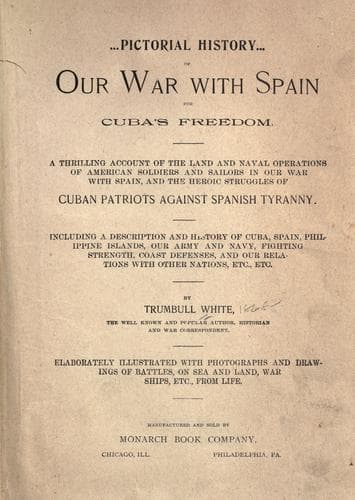
Our War with Spain for Cuba's FreedomWhite, Trumbull
History
Our War with Spain for Cuba's Freedom
White, Trumbull
Cuba -- History; Spain -- Foreign relations -- United States; Spanish-American War, 1898; United States -- Foreign relations -- Spain
Those who are acquainted with the nature of the service usually
required of cavalry in time of war will not question the
usefulness of the cowboy regiment--rough riders as they are
called--that were raised in the West to take part in the invasion
of Cuba.
The cowboy is a rapidly passing type. Barbed wire, the fencing in
of the range, together with the irrigation and cultivation of
those regions which were once marked as deserts on the maps--have
been responsible for his undoing and he has made what may prove to
be his last stand, as a soldier.
The cowboy regiment was the idea of the assistant secretary of the
navy, Theodore Roosevelt, who had had some experience himself as a
cowboy on his Wyoming ranch and who was an expert in such matters
as branding, rope-throwing, broncho breaking and those other
practices which are peculiar to the "cow-puncher."
Lieutenant-Colonel Roosevelt's regiment, which figures on the army
records as the "1st regiment of rifle rangers," but which the
general public from the first preferred to call "Roosevelt's rough
riders," or more simply still, "Teddy's terrors," was made up
almost entirely of cowboys, with a small sprinkling of society
men, who had both a fondness and an aptitude for horsemanship,
which had found no other outlet than that offered by the hunting
field and the polo ground.
MADE UP ALMOST ENTIRELY OF COWBOYS.
In organization the regiment was not widely different from the
famous Texas Rangers, but the uniform was the same as that of the
cavalrymen of the regular army, slightly modified. Its personnel,
with the exception of the millionaire members--was about the same,
however, as that of the Rangers. It included men from almost every
State in the Union, and they could one and all ride well, and
shoot well, and many of them smelled powder in more than one
Indian war.
While Lieutenant-Colonel Roosevelt took the most active part in
its formation, he did not command the regiment. That
responsibility was delegated to Colonel Wood, who was almost as
well known in the West as Roosevelt was in the East. He entered
the army as a surgeon, but he probably had much more to do with
the making of wounds than their healing.
It is said of him that when he was first assigned for duty to an
Arizona post he arrived at the post one night at 7 o'clock, and
the next morning at 4 was in the field and at work. This was
during the Apache campaign in 1885, and Surgeon Wood soon won for
himself the name of the fighting doctor. He was conspicuous in the
famous Geronimo outbreak, having command at various times of the
infantry and scouts engaged in the chase after that wily savage.
Public-domain text, read in full here on John Shaqi.
Reviews
Reviews
No reviews yet
Be the first to share your thoughts on this work.
Elsewhere in the archive
Join the Discussion
Join the discussion
Sign in to leave a comment or review.
Sign InorCreate an account