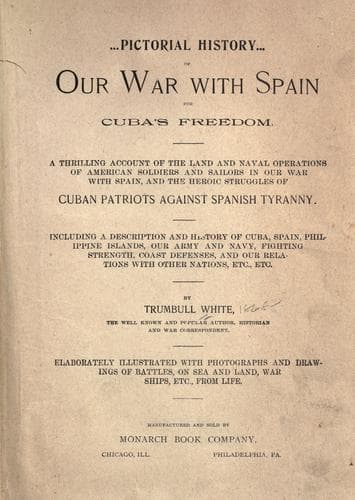
Our War with Spain for Cuba's FreedomWhite, Trumbull
History
Our War with Spain for Cuba's Freedom
White, Trumbull
Cuba -- History; Spain -- Foreign relations -- United States; Spanish-American War, 1898; United States -- Foreign relations -- Spain
That is why we restrained and punished those who organized
expeditions to help the Cubans while we were still at peace with
Spain. But nations engaged in war must not ask too much. They may
insist that a neutral shall allow no hostile operations to be
carried on within its territory, but they have no right to demand
that it shall punish its private citizens for engaging in trade in
articles that may be helpful to the enemy, for that would be
imposing too much trouble and expense upon a nation which has no
concern in the quarrel. Such trade is punishable, but it is the
business of the nation injured by it to catch the ships engaged in
it and enforce the penalty--which is usually confiscation of the
goods as "contraband of war." To do this it may stop and search
any ships--except warships--which it finds at sea; and so long as
no outrages are committed the neutral must submit and has no
ground for complaint. Trade in contraband goods is tolerated, but
it is carried on at the trader's own risk. His government will not
undertake to protect him from the legitimate consequences of his
venture.
As has been stated, the contraband goods are confiscated by the
captor. The vessel, however, must be captured while the guilty
goods are still on board; to seize the proceeds after the cargo
has been sold and landed is not allowable, though it has sometimes
been done. If the ship belongs to the same owner as the forfeited
goods, it, too, is confiscated; otherwise it goes free after the
goods are taken off.
It is very important to know just what articles are contraband and
what are not; but this is often hard to decide. There is no
question about weapons, military equipments and ammunition. These
are plainly contraband, and the materials from which they are made
are classed with them whenever they seem intended for military
uses. Thus sulphur and saltpeter are always contraband. The
detached parts of cannon and naval engines do escape by the trick
of separation.
Cloth is not contraband in itself, but if of a quality evidently
designed for the manufacture of uniform it would probably be
seized. Horses are so useful in war that most nations treat them
as contraband--though, oddly enough, Russia has never done so.
Still more objectionable, nowadays, is coal, which will never be
allowed to reach the bunkers of hostile warships if it can be
prevented. This shows plainly how uncertain and changeful is the
list, for fifty years ago coal was as free as provisions, though
even food must not be run through the lines of a blockade.
Public-domain text, read in full here on John Shaqi.
Reviews
Reviews
No reviews yet
Be the first to share your thoughts on this work.
Elsewhere in the archive
Join the Discussion
Join the discussion
Sign in to leave a comment or review.
Sign InorCreate an account