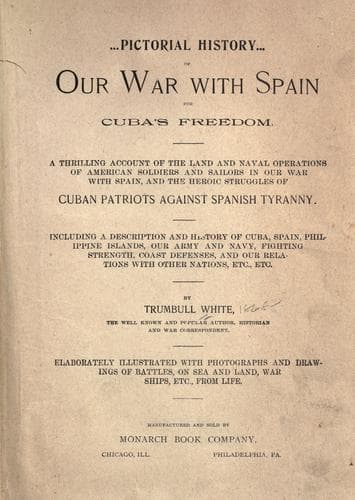
Our War with Spain for Cuba's FreedomWhite, Trumbull
History
Our War with Spain for Cuba's Freedom
White, Trumbull
Cuba -- History; Spain -- Foreign relations -- United States; Spanish-American War, 1898; United States -- Foreign relations -- Spain
Articles, such as coal, which are of great value in war, but are
also largely used for peaceful purposes, are called "occasional
contraband" and their seizure has given rise to endless disputes.
There is no justice in treating them as contraband except when
they are obviously destined for hostile use. Sometimes, in
doubtful cases, such goods, instead of being confiscated, are
seized and paid for to prevent their reaching the enemy. This is
called "pre-emption;" but, fair as it seems, there is much danger
that it will be made a pretext for appropriating goods which ought
to go quite free, and the practice is generally condemned.
Search at sea is extremely annoying, and ships entirely innocent
of contraband are often subjected to great inconvenience. That
must be endured; to attempt to resist or escape would make them
liable to confiscation, whatever their cargo might prove to be.
Only properly commissioned vessels, however, are entitled to hold
up merchantmen for this purpose. Another kind of meddling in war
for which a neutral citizen may be punished by confiscation, but
for which his government is not held responsible, is blockade
running.
A blockade, such as we maintained around Cuba, is established by
stationing war vessels at the entrances of harbors and at
intervals along the blockaded coast. Its purpose is to cut off
supplies and stop all communication with the enemy by sea. The
merchant ships of all nations are therefore forbidden to pass or
even to approach the line, and the penalty for disobedience is the
confiscation of both ship and cargo--whether the latter is
contraband or not here makes no difference. If the ship does not
stop when hailed she may be fired upon, and if she is sunk while
endeavoring to escape it is her own fault. And unlike vessels
merely guilty of carrying contraband, she is no less liable to
seizure on her return voyage, after her cargo has been disposed
of. Altogether, blockade running is perilous business. It is
usually attempted under cover of night or stormy weather, and it
is as full of excitement and adventure as war itself. The motive
is usually either to take advantage of famine prices, or to aid
the enemy by bringing supplies or carrying dispatches.
Public-domain text, read in full here on John Shaqi.
Reviews
Reviews
No reviews yet
Be the first to share your thoughts on this work.
Elsewhere in the archive
Join the Discussion
Join the discussion
Sign in to leave a comment or review.
Sign InorCreate an account