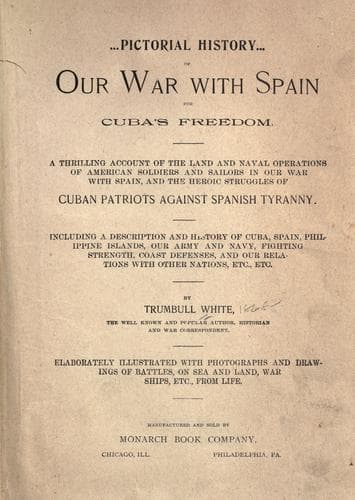
Our War with Spain for Cuba's FreedomWhite, Trumbull
History
Our War with Spain for Cuba's Freedom
White, Trumbull
Cuba -- History; Spain -- Foreign relations -- United States; Spanish-American War, 1898; United States -- Foreign relations -- Spain
5. After the foregoing deductions, the residue is distributed
among the others doing duty on board, and borne upon the books of
the ship, in proportion to their respective rates of pay.
All vessels of the navy within signal distance of the vessel
making the capture, and in such condition as to be able to render
effective aid if required, will share in the prize. Any person
temporarily absent from his vessel may share in the captures made
during his absence. The prize court determines what vessels shall
share in a prize, and also whether a prize was superior or
inferior to the vessel or vessels making the capture.
The share of prize money awarded to the United States is set apart
forever as a fund for the payment of pensions to naval officers,
seamen and marines entitled to pensions.
CHAPTER XLV.
SPANISH DISSENSIONS AT HOME.
Spain Threatened with Interior Difficulties--Danger that the
Crown Might Be Lost to the Baby King of Spain--Don Carlos and the
Carlists Are Active--Castelar Is Asked to Establish a Republic--
General Weyler as a Possible Dictator--History of the Carlist
Movement and Sketch of "the Pretender."
While these events were in progress in the international
relations of the United States and Spain, with a threat of a
hopeless war hanging over the latter, the embarrassments of the
government of the peninsular kingdom as to the conflict of its own
affairs at home multiplied daily. Altogether aside from the
prospective operations of the war itself the Queen Regent and her
Ministry had more than one local difficulty to face.
It was frankly recognized in their inner councils that a
succession of Spanish defeats, in all probability, would lose the
throne to the dynasty and that the boy king would never wear the
crown of his father. A second threat of danger was that in the
midst of difficulties abroad there would be an uprising of the
adherents of Don Carlos "The Pretender," who would take advantage
of the situation to start a civil war and seize the authority. In
addition to all this, the republicans of Spain, growing more
restless under the misgovernment they saw, united in an address to
Castelar, who was formerly the president of the Spanish republic,
urging that he declare the republic again established and
promising to support him in such a movement. The names of 20,000
of the best citizens of Spain were signed to this request, and it
was an element of danger to the monarchy that was well recognized.
Finally, the partisans of General Weyler, who comprised a large
element of the proudest and most influential people of Spain,
showed distinct signs of a desire to establish a dictatorship with
that ferocious general as the supreme authority. He had been
recalled from Cuba as a rebuke and in order to alter the policies
which he had established there. His friends were ready to resent
the rebuke and offer him higher place than he had had before.
DON CARLOS AND THE CARLISTS.
Public-domain text, read in full here on John Shaqi.
Reviews
Reviews
No reviews yet
Be the first to share your thoughts on this work.
Elsewhere in the archive
Join the Discussion
Join the discussion
Sign in to leave a comment or review.
Sign InorCreate an account