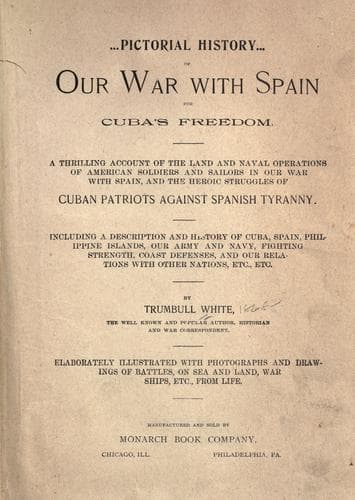
Our War with Spain for Cuba's FreedomWhite, Trumbull
History
Our War with Spain for Cuba's Freedom
White, Trumbull
Cuba -- History; Spain -- Foreign relations -- United States; Spanish-American War, 1898; United States -- Foreign relations -- Spain
In time of war properly commissioned ships are entitled to capture
not only the armed vessels but also the helpless merchantmen of
the enemy. It does seem a good deal like piracy, but it has been
the universal practice from time immemorial. These captured
vessels are taken to some convenient port of the captor's own
country that the courts may pass judgment on them, and if there
has been no mistake made in the seizure they are forthwith
condemned as "lawful prize." Then they are sold, and "prize money"
is awarded the captors in proportion to the value of the prize.
The cargo is treated in the same way, unless it happens to belong
to a neutral, in which case it is free; though the owner must put
up with the inconvenience and delay resulting from the seizure,
since he deliberately took that risk when he placed his goods in a
hostile craft. Formerly his property was sometimes confiscated
under these circumstances, but the treaty of Paris, already
mentioned, put a stop to that. Formerly, too, the goods of enemies
could be taken from neutral ships and confiscated in the same
manner as contraband of war, but the treaty of Paris made an end
of that also.
Another excellent rule adopted on that notable occasion abolished
privateering. Privateers were armed ships belonging to private
citizens who had obtained from their own government a commission
(letter of marque) which authorized them to make prize of the
enemy's merchant vessels and appropriate the proceeds. The
abolition of privateering was a long step in the right direction,
for the privateer's motive was mainly plunder, and the whole
business was really close kin to piracy. Neither the United States
nor Spain signed the original agreement, but both have acceded to
it now--Spain, evidently, very much against her will, for her
citizens thirsted for the rich booty of our commerce, a fact which
makes supremely ridiculous her crazy ravings against our
legitimate captures as "American piracy."
DISTRIBUTION OF PRIZE MONEY.
The prize money adjudged to captors is distributed in the
following proportions:
1. The commander of a fleet or squadron, one-twentieth part of all
prize money awarded to any vessel or vessels under his immediate
command.
2. To the commander of a division of a fleet or squadron, a sum
equal to one-fiftieth of any prize money awarded to a vessel of
the division under his command, to be paid from the moiety due the
United States, if there be such moiety; if not, from the amount
awarded the captors.
3. To the fleet captain, one-hundredth part of all prize money
awarded to any vessel of the fleet in which he is serving, in
which case he shall share in proportion to his pay, with the other
officers and men on board such vessel.
4. To the commander of a single vessel, one-tenth of all the prize
money awarded to the vessel.
Public-domain text, read in full here on John Shaqi.
Reviews
Reviews
No reviews yet
Be the first to share your thoughts on this work.
Elsewhere in the archive
Join the Discussion
Join the discussion
Sign in to leave a comment or review.
Sign InorCreate an account