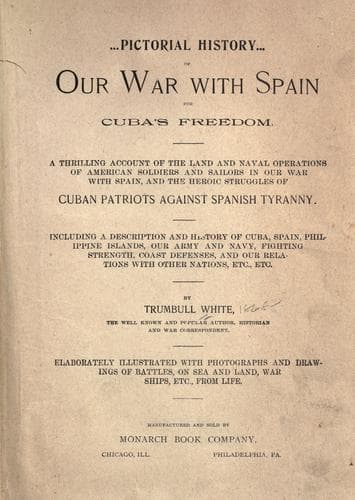
Our War with Spain for Cuba's FreedomWhite, Trumbull
History
Our War with Spain for Cuba's Freedom
White, Trumbull
Cuba -- History; Spain -- Foreign relations -- United States; Spanish-American War, 1898; United States -- Foreign relations -- Spain
His agents have been working among the army officers, and it is
said that they have secured many recruits for their cause. The
throne of Spain, like the throne of Russia, during the last
century, or that of Borne in the days of the empire, rests largely
upon the army, and if the army, discontented and dissatisfied as
it certainly is, were to revolt, Don Carlos' success would be
almost certain.
Ever since his marriage in 1894 with the Princess de Rohan, who
brought him a large fortune, Don Carlos has been watching a
favorable opportunity for a coup. There cannot be a better one
than that which will be offered when Spain is defeated by the
United States, and it would not be surprising to see Don Carlos
unfurl his banner to the breeze and call for troops to rally to
his standard.
Those who are supporters of the pretensions of Don Carlos believe
they have right on their side. His supporters love him with the
loyalty of the legitimists to the house of Stuart during the
period before the restoration in England. His personality is
attractive. He has all the elements of personal popularity with
the masses. He is brave and dashing. He does not sit and weep over
the fallen glories of his race, but he is always ready for action.
He is ready at any moment to lead an army in a forlorn cause and
will fight, for what he believes to be his rights.
FLOWER OF SPAIN.
The position occupied in Spanish affairs by Don Carlos is similar
to that occupied by Prince Charles Edward toward the throne of
Great Britain during the last century. His family has been
dispossessed for about the same length of time and he has made a
fight just as romantic, but with more brilliant prospects, and at
the head of the heroic highlanders, dwellers in the Basque
mountains. His followers are the flower of Spain, the most
aristocratic families in the kingdom, willing to risk all in his
support, setting property and life itself as worth naught compared
with their honor.
There have been three Carlist pretenders to the throne of Spain.
The first was Carlos V., born in 1788. He laid claim to the throne
on the death of his brother, Ferdinand VII., in 1833.
Ferdinand had had a stormy reign, torn by dissensions between the
court and the popular party. Napoleon compelled him to resign in
favor of Joseph Bonaparte, but he returned to the throne of his
ancestors upon the fall of Bonaparte. During twenty-eight years he
married five wives in succession. By four of these he had no
children, but a daughter was born to the last, who had been
Princess of Naples. She secured an absolute mastery of the king,
who was an imbecile unfitted to reign. The heir apparent to the
throne was the grandfather of the present Don Carlos, Carlos V.,
the brother of Ferdinand. Between Carlos and his brother there had
been a long enmity.
Public-domain text, read in full here on John Shaqi.
Reviews
Reviews
No reviews yet
Be the first to share your thoughts on this work.
Elsewhere in the archive
Join the Discussion
Join the discussion
Sign in to leave a comment or review.
Sign InorCreate an account