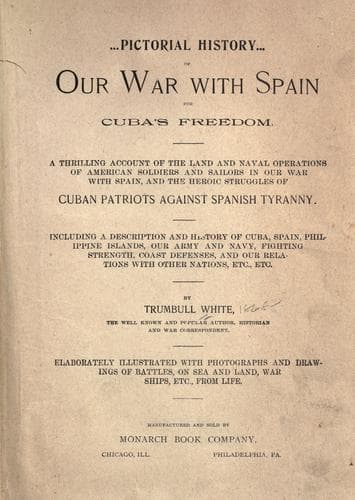
Our War with Spain for Cuba's FreedomWhite, Trumbull
History
Our War with Spain for Cuba's Freedom
White, Trumbull
Cuba -- History; Spain -- Foreign relations -- United States; Spanish-American War, 1898; United States -- Foreign relations -- Spain
Christina used her influence with her husband to persuade him to
disinherit his brother. By the Salic law females were excluded
from inheriting the throne of France. But through the influence of
Ferdinand and his spouse the cortes was persuaded to repeal the
law, the more willingly since Carlos was in favor of absolutism,
while with a woman as ruler the chances would be better for the
perpetuation of constitutionalism. The Carlists claim that during
the last days Ferdinand repented his act and issued documents
which would have established Carlos' right to the succession, but
that these were suppressed. However that may be, upon the death of
Ferdinand his baby daughter was declared Queen of Spain, with her
mother as regent.
For five years there was civil war. The youth and weakness of the
baby queen proved her strength. The liberals believed that with
her as the nominal ruler the continuance of the constitutional
monarchy would be assured. For the same reasons France and England
supported Isabella. These were odds against which Carlos could not
effectually fight, and in 1869 he retreated from Spain, and the
historians treat the succession as settled in favor of the young
girl, who even at that time was not in her teens.
QUEEN ISABELLA'S REIGN.
Isabella II., or rather her mother, for the latter was the real
ruler, did not rule with prudence. Scandals disgraced the reign,
and led to the regent's removal from the regency. Queen Isabella's
ill-fated marriage and other intrigues led to domestic
disturbances which kept alive the pretensions of the Carlists.
Upon the death of the first pretender, in 1853, a second arose in
the person of his son, Don Carlos, Count de Montemolim. He
attempted to cause a revolution in 1860, but was arrested with his
brother, and they were not liberated until they had signed a
renunciation of their claims to the throne.
The second pretender died in 1861, and then the present Don Carlos
arose. He was the son of Don Juan, and a brother of the two who
had renounced their claims to the Spanish throne, and he claimed
that their renunciation could not be binding on him. This was the
Don Carlos who is now the leader of the legitimists, and he has
never renounced his claim to the throne of his ancestors.
His name in full is Don Carlos de los Dolores Juan Isidore Josef
Francisco Quirino Antonio Miguel Gabriel Rafael. He was born in
the little village of Laibach in the Austrian Alps, while his
parents were on a journey through the country, and from his
infancy his career has been surrounded with a romance which has
endeared him to the hearts of his followers. His father, Don Juan,
was an exile from Spain and a royal wanderer seeking a place where
he could end his life in peace.
Public-domain text, read in full here on John Shaqi.
Reviews
Reviews
No reviews yet
Be the first to share your thoughts on this work.
Elsewhere in the archive
Join the Discussion
Join the discussion
Sign in to leave a comment or review.
Sign InorCreate an account