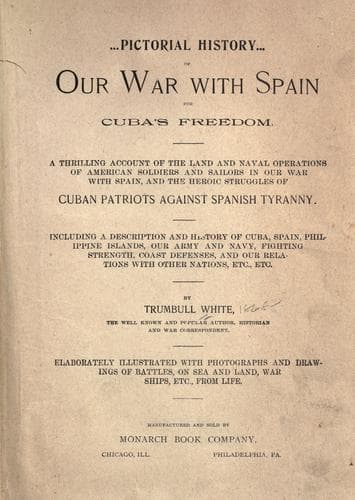
Our War with Spain for Cuba's FreedomWhite, Trumbull
History
Our War with Spain for Cuba's Freedom
White, Trumbull
Cuba -- History; Spain -- Foreign relations -- United States; Spanish-American War, 1898; United States -- Foreign relations -- Spain
Yet in spite of this declaration and in spite of the fact that the
five successive heads of the Madrid government recognized the
belligerency of the Carlists by conventions; that treaties were
made for the running of railroads and for other purposes, and that
the Carlists, had a mint, postoffice and all of the equipments of
a regular government, recognition was withheld by the powers.
Everything depended upon England, and General Kirkpatrick, a
brigadier general in the civil war, who represented the Carlists
as charge d'affaires at London, was unable to secure that boon
from Gladstone, and none of the continental powers would act until
England had led the way.
After his retirement from Spain, when the war had exhausted his
resources, Don Carlos lived humbly and quietly at Paris. He had
ceased to love his wife and they led a miserable domestic life. He
would sell his war horse and fling the money to her on the bare
table, telling her to buy bread with it. Then his friends would
buy the horse back again. Once he disposed of the badge of the
Order of Golden Fleece that had decorated the son of his
illustrious ancestor, Charles V. The discreditable part of this
action was not so much in the actual act of pawning as that he put
the blame for it on an old general who had served him with
fidelity for twenty years. He claimed that the general had stolen
it, imagining that the old soldier's devotion to his interests
would induce him to remain silent. But the general at once told
all of the facts in the case, and also told how Don Carlos had
used the money to satisfy the demands of a notorious demi-mondaine.
His financial difficulties came to an end with the death of the
Comte and Comtesse de Chambord, who bequeathed the larger part of
their immense wealth to their favorite niece, wife of Don Carlos.
The duchess kept the money in her own hands, but gave him all he
needed. At her death she was quite as provident, leaving the money
in trust for her children and giving only a small allowance to her
husband, from whom she had lived apart for fifteen years.
MARRIED A FORTUNE.
This threw the pretender again into financial straits, for he has
expensive tastes which require a large fortune to support. So he
looked around for a bride. His followers were startled to hear of
his marriage to the wealthy Princess Marie Berthe de Rohan. The
marriage took place April 29, 1894, and, although she was handsome
and exceedingly rich and a member of the illustrious Rohan family,
which alone of all the noble families of France and Austria has
the privilege of calling the monarch cousin--it was regarded as a
mesalliance by all of the Carlists in Spain and legitimists
everywhere. They believed that Don Carlos should have not married
any but the scion of a royal house.
Public-domain text, read in full here on John Shaqi.
Reviews
Reviews
No reviews yet
Be the first to share your thoughts on this work.
Elsewhere in the archive
Join the Discussion
Join the discussion
Sign in to leave a comment or review.
Sign InorCreate an account