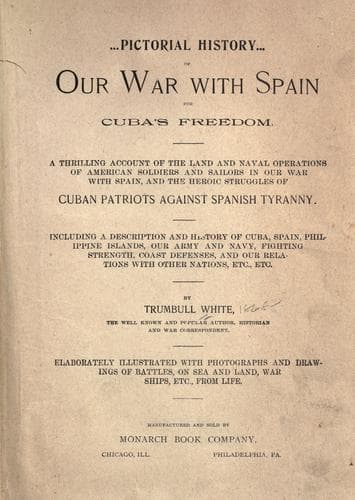
Our War with Spain for Cuba's FreedomWhite, Trumbull
History
Our War with Spain for Cuba's Freedom
White, Trumbull
Cuba -- History; Spain -- Foreign relations -- United States; Spanish-American War, 1898; United States -- Foreign relations -- Spain
Thereupon the two chambers combined as the sovereign power of Spain and
voted for a republic. The two years of the republic were the stormiest
in Spanish history, and it was then that the Carlists made the greatest
progress. They numbered probably one-third of the people of Spain. A
republic was not suited to the disposition of the Spaniards, and
Castelar, who had the helm of the ship of state, gave up his task in
disgust. Then Alfonso XII., son of the exiled Isabella, was proclaimed
heir to the throne. Alfonso XIII., is his son.
Alfonso XII.'s first task was to suppress the Carlists, and in
this he succeeded. The people were tired of the continual strife.
Royalists and republicans alike welcomed the new monarch.
The number of his followers gradually dwindling and finding that
continued resistance would be unavailable, Don Carlos was finally
convinced that it would be useless to continue the struggle. So
early in 1876 his army disbanded. Accompanied by his bodyguard he
crossed the Pyrenees. As he stepped his foot on French soil he
turned as if to bid farewell to Spain, but his last words,
energetically pronounced, were: "Volvere, volvere! I will return,
I will return!" And it is the belief of his followers that his
time is near at hand.
HIS LOYAL FOLLOWERS.
No man has more devoted followers. The army that fought for him
during the Carlist revolution was one of the most heroic that has
ever been gathered together. To his standard came young men of
good family from every nation. He was regarded as the
representative of the old regime of monarchists, and in his ranks
were those who hoped for the re-establishment of the now obsolete
divine right of kings. He was the head of the house of Bourbon in
all Europe. Except for the existence of Maria Theresa, daughter of
Ferdinand of Modena, married the Prince Louis of Bavaria, Don
Carlos would be the legitimate representative of the royal house
of Stuart, and, barring the English act of settlement, King of
Great Britain and Ireland.
This fact may have had something to do with the cold shoulder that
was turned to him by all of the powers of Europe. Don Carlos was
regarded as the representative of the half-dozen pretenders to the
throne who live in exile amid little courts of their own and build
air castles peopled with things they will do when they mount the
thrones of which they believe themselves to have been defrauded.
The Carlists believe that with the support of one of the great
governments they would have won. But they could obtain no
recognition even of their belligerency, and that was in spite of
the fact that, as early as 1873, the president of the Spanish
Republic has declared in the cortes: "We have a real civil war.
... It has a real administrative organization and collects taxes.
You have presented to you one state in front of another. It is in
fact a great war."
Public-domain text, read in full here on John Shaqi.
Reviews
Reviews
No reviews yet
Be the first to share your thoughts on this work.
Elsewhere in the archive
Join the Discussion
Join the discussion
Sign in to leave a comment or review.
Sign InorCreate an account