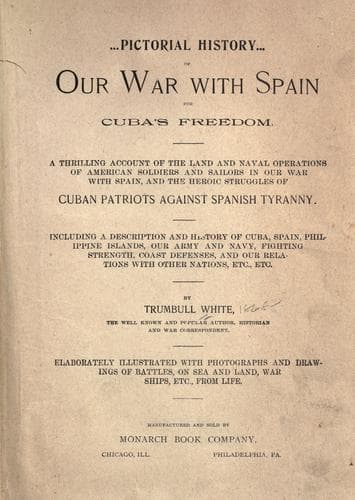
Our War with Spain for Cuba's FreedomWhite, Trumbull
History
Our War with Spain for Cuba's Freedom
White, Trumbull
Cuba -- History; Spain -- Foreign relations -- United States; Spanish-American War, 1898; United States -- Foreign relations -- Spain
From the very beginning of our war with Spain the peninsular
kingdom had reason to fear that the loss of Cuba would be but one
of the disasters to befall it in the war with the United States.
It was recognized in all quarters that the Queen Regent would have
been willing to let the Cuban insurrectionists have their island
without further protest, had it not been for the fact that giving
up probably would have incited an insurrection at home, resulting
in a loss of the crown to her son before he should have a chance
to wear it.
It was quite well understood as a like probability that the
Philippine islands, that splendid colony of Spain in the East
Indies, would be lost to Spanish control at the same time, and
that the island of Puerto Rico, the last remnant of Spain's great
colonial possessions in the Western hemisphere, after Cuba's loss,
would gain its freedom too. The Queen Regent having spurned the
only course in Cuban affairs which the United States would permit,
with American war-ships threatening Manila, it became immediately
apparent that the other horn of the dilemma which had been chosen
was as fatal to Spanish sovereignty as the first would have been.
Even Cuba, with all its abominations, scarcely afforded so
remarkable a picture of Spanish oppression, miscalled government,
as may be seen in the Philippines. It is only the remoteness and
isolation of these unhappy islands that has prevented the
atrocities there perpetrated from arousing the indignation of the
whole world. Readers are familiar enough with the shocking
barbarities practiced in times of disorder by the Spanish
authorities, and they do not need to be multiplied here, but in
the Philippines is demonstrated the utter incapacity of the
Spanish for the exercise of civilized government over a dependent
province even in times of so-called peace.
The Philippines are extremely interesting in themselves, but are
seldom visited by tourists, partly in consequence of their lying
out of the ordinary lines of travel and partly because of the
policy of Chinese seclusion cultivated by the government. The
climate, too, is unhealthy, even beyond what is usual in the
tropics, and the unsettled state of the country, swarming with
exasperated savages and bandits of the worst description, makes
excursions beyond the limits of the principal cities very
perilous. About 600 islands are included in the group, and the
total area is considerable--some 150,000 square miles, three or
four times that of Cuba, Exact data, however, are difficult to
obtain. There are a multitude of insignificant islets hardly known
except upon the charts of navigators; but Luzon almost equals Cuba
in extent. Altogether the islands probably contain less than
8,000,000 souls; so that Spanish cruelty finds plenty of raw
material to work upon.
CHARACTERISTICS OF THE POPULATION.
Public-domain text, read in full here on John Shaqi.
Reviews
Reviews
No reviews yet
Be the first to share your thoughts on this work.
Elsewhere in the archive
Join the Discussion
Join the discussion
Sign in to leave a comment or review.
Sign InorCreate an account