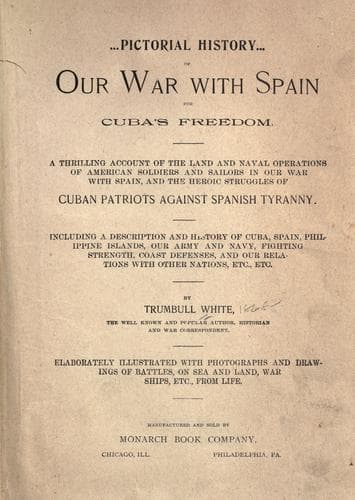
Our War with Spain for Cuba's FreedomWhite, Trumbull
History
Our War with Spain for Cuba's Freedom
White, Trumbull
Cuba -- History; Spain -- Foreign relations -- United States; Spanish-American War, 1898; United States -- Foreign relations -- Spain
And most of it is raw to the last degree--a medley of diverse and
hostile races, ranging from the puny and dying remnant of the
Negritos, who live like wild beasts in the highlands, subsisting
upon the roots which they claw out of the ground, to the fierce
and unsubdued Mohammedan tribes that still keep up the bloody war
of creeds which raged in Spain itself for so many centuries. These
latter are chiefly of Malay origin and many of them are
professional head-hunters, well qualified to retort Spanish
outrages in kind. There are also Chinese in large numbers and
half-castes of all varieties. The proportion of Europeans is
small, even in the cities. The resident Spaniards are all soldiers
or officials of some sort and are there simply for what they can
make by extortion and corrupt practices.
The Philippine islands were discovered in 1521 by Magellan, the
circumnavigator, and were conquered by Spain and made a colony in
the reign of Philip II., for whom they were named, half a century
later. Spanish sway never has extended over more than half of the
1,400 islands of the archipelago, the others remaining under their
native wild tribes and Mohammedan rulers. The conjectural area is
about 120,000 square miles, and the estimated population about
7,500,000. About half this area and three-quarters of this
population are nominally under Spanish rule, but the insurrection
has left things in a good deal of doubt. The remainder of the
people are governed according to their own customs, by independent
native princes. Education is exceedingly backward. The Roman
Catholic clergy have been industrious, and probably 2,500,000
natives are nominal converts to the Christian religion; but
education has advanced very little among them. There is a Roman
Catholic archbishop of Manila, besides three bishops.
The history of the Philippines has included a succession of
revolutions against Spanish authority, put down by ferocious
warfare and cruelty on the part of the victors. The conversion and
subjugation of the islands were not accompanied by quite the
horrors that characterized the Spanish conquest of South America,
but the record is second only to that. Manila was captured by the
English in 1762 and was held by them for two years until ransomed
by the Spanish by a payment of 1,000,000 pounds. Contests with
rebellious tribes, attacks by pirates, volcanic eruptions,
earthquakes and tornadoes help to break the monotony of the
history.
MANILA, THE CAPITAL OF THE COLONY.
Public-domain text, read in full here on John Shaqi.
Reviews
Reviews
No reviews yet
Be the first to share your thoughts on this work.
Elsewhere in the archive
Join the Discussion
Join the discussion
Sign in to leave a comment or review.
Sign InorCreate an account