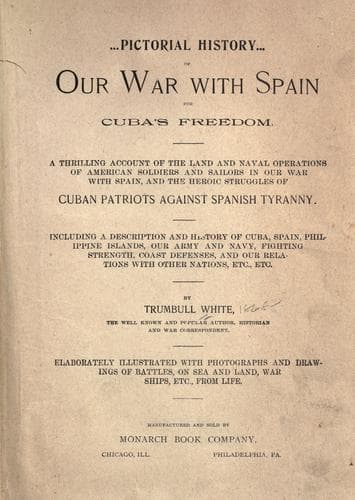
Our War with Spain for Cuba's FreedomWhite, Trumbull
History
Our War with Spain for Cuba's Freedom
White, Trumbull
Cuba -- History; Spain -- Foreign relations -- United States; Spanish-American War, 1898; United States -- Foreign relations -- Spain
Manila, the capital city of the colony and of Luzon, the largest
island, lies 628 miles, or sixty hours' easy steaming, southeast
of Hongkong, and twice that distance northeast of Singapore. The
population of the city is about 330,000, of whom only 10,000--
including troops, government officials and clergy--are Europeans,
and not more than 500 are English-speaking people. A few American
houses have branches in Manila, so that there is an American
population of perhaps 100. The city faces a fine bay, into which
flows the River Pasig. Most of the Europeans live in Binondo, a
beautiful suburb on higher ground, across the river. There are
many native dialects, but the social, official and business idiom
is Spanish. The army of Spanish civil, religious, military and
naval officials is a leech on the people in the same fashion as it
was in Cuba. All the places of profit are monopolized by them,
appointments to choice offices in the Philippines being given to
those whom it is desired to reward for service to the government
in Spain. It is quite well understood that such an appointee is
expected to gain a fortune as rapidly as he can, by any method
possible, so that he may give way for some one else to be brought
over from Spain for a similar reward. The policy is the same as
the colonial policy of Spain in Cuba was, and the same results
have followed.
But, indeed, pillage of the wretched natives is the almost open
aim of the government--the sole end for which it is organized and
maintained; so why should petty officials be scrupulous? It is the
old Roman provincial system, denounced by Cicero 2,000 years ago,
but in Spain unforgotten and unimproved. What other use has she
for dependencies, except as a source of revenue wrung by torture
from the misery of slaves, and incidentally as a battening ground
for her savage war dogs? Here the detestable Weyler is said to
have accumulated a fortune of several millions of dollars in three
years--more than twenty times the whole amount of his salary!
The methods employed in this legalized system of robbery are
medieval in character, but often highly ingenious. One of them is
the "cedula personal," a sort of passport. Every person in the
islands and over eighteen years of age and accessible to the
authorities is required to take out one of these documents; even
the women are not exempt. The cedula must be renewed annually and
the cost is from $1.50 to $25, according to circumstances--the
chief circumstances being the victim's ability to pay. This in a
country where wages sometimes fall as low as five cents a day! And
any one who holds a cedula costing less than $3 is further
required to render the government fifteen days of unremunerated
labor.
INSTANCES OF PETTY EXTORTION.
Public-domain text, read in full here on John Shaqi.
Reviews
Reviews
No reviews yet
Be the first to share your thoughts on this work.
Elsewhere in the archive
Join the Discussion
Join the discussion
Sign in to leave a comment or review.
Sign InorCreate an account