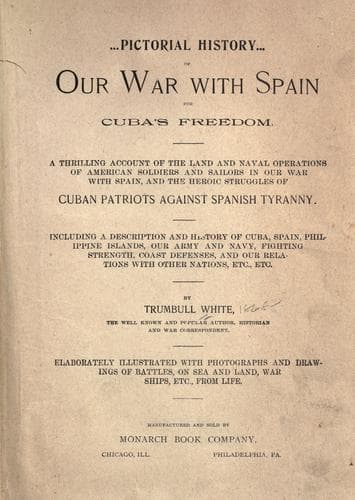
Our War with Spain for Cuba's FreedomWhite, Trumbull
History
Our War with Spain for Cuba's Freedom
White, Trumbull
Cuba -- History; Spain -- Foreign relations -- United States; Spanish-American War, 1898; United States -- Foreign relations -- Spain
Manila has cable connection with the rest of the world, and
regular lines of passenger steamers. The European colony has its
daily papers, which are, however, under strict censorship,
religious and military, and keeps up with the news and the
fashions of the day. Until the insurrection of the last two years,
the army, except two Spanish brigades of artillery and a corps of
engineers, was composed of natives and consisted of seven
regiments of infantry and one of cavalry. There was also a body of
Spanish militia in Manila, a volunteer corps similar to the one
which was always maintained in Havana under Spanish rule, which
could be called out by the captain-general in the event of need.
SPAIN'S FEEBLE CONTROL OF THE ISLANDS.
When the latest insurrection began, Spain shipped to its far-off
colony all the men who could be spared from service in Cuba, and
after a few months of fighting it was announced that the rebellion
was crushed. As a matter of fact, however, Spain has control of
but a comparatively small part of the islands, and the natives
elsewhere are as free from obligation to pay Spanish taxes as they
were before the discovery.
Trade restrictions have hampered the commercial progress of the colony,
but in spite of that fact their trade with the outside world is a large
one. For many years after the conquest but one vessel a year was
permitted to ply between Manila and the Spanish-American port of
Acapulco. Then the number was increased to five. Then a Spanish
chartered company was given a monopoly of the trade of the islands. When
that monopoly expired, other houses began business, until finally many
large English and German firms shared the trade, while American houses
and American ships were by no means at the foot of the list. The total
volume of the exports and imports is about $75,000,000 annually.
The manufactures of the Philippines consist chiefly of textile
fabrics of pineapple fiber, silk and cotton; hats, mats, baskets,
rope, furniture, pottery and musical instruments. Vegetable
products of great value are indigo, cocoa, sugar, rice, bamboo,
hemp and tobacco. Coffee, pepper and cassia grow wild in
sufficient quantity and quality to provide a living for those who
wish to take advantage of what nature has provided. Coal, gold,
iron and copper are mined with profit. The soil is exceedingly
fertile, and although the climate is tropical, with little change
except between wet and dry seasons, it has not been difficult for
Europeans to accustom themselves to it. The largest island is
nearly 500 miles long and 125 miles wide, while others are more
than half as large. It must be remembered that the interior of
these great islands, and the whole of hundreds of the smaller
ones, are unexplored and almost unvisited by travelers from
civilized lands, as Spanish exploration has been of little
practical value to the rest of the world or to science.
PUERTO RICO.
Public-domain text, read in full here on John Shaqi.
Reviews
Reviews
No reviews yet
Be the first to share your thoughts on this work.
Elsewhere in the archive
Join the Discussion
Join the discussion
Sign in to leave a comment or review.
Sign InorCreate an account