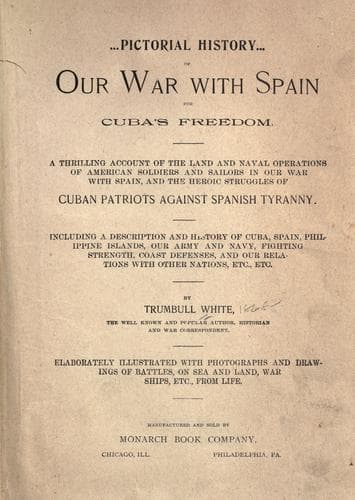
Our War with Spain for Cuba's FreedomWhite, Trumbull
History
Our War with Spain for Cuba's Freedom
White, Trumbull
Cuba -- History; Spain -- Foreign relations -- United States; Spanish-American War, 1898; United States -- Foreign relations -- Spain
Puerto Rico, the smaller of the two islands which Spain held in
the West Indies, was discovered by Columbus in 1493 and occupied
by soldiers under Ponce de Leon early in the sixteenth century. It
lies well outside the Caribbean sea, in the open Atlantic, and for
this reason it is not at all affected climatically, as Cuba is, by
proximity to the continent. Its climate is determined mostly by
the ocean, whose breezes sweep constantly over the entire island,
tempering deliciously the tropical heat, of the sun.
The surface of the island is equally favorable to excellent
climatic conditions. It has no mountains, but it has hills that
extend from end to end of it and form a perfect watershed and
afford drainage for plains and valleys. Thirteen hundred rivers,
forty-seven of them navigable, drain 3,500 square miles of
territory, a territory as large as the state of Delaware. All over
its extent are, besides the principal range of hills that are by
some called mountains, round-topped hills of finest soil, which
are nearly every one cultivated. In summer the heat is not
excessive in the valleys and in winter ice never forms oil the
hills. It is a purely agricultural country and the great majority
of the natives are farmers. In the population of 810,000 are
300,000 negroes, who are now free, and since their freedom have
gone into the towns and cities and found work in the sugar mills
and at similar employments.
The native Puerto Ricans adhere to the soil. Their labors are not
severe where the soil is loose and rich, as it is every where
except near the seashore, and for reasons already stated the
climate is very favorable to a comfortable existence. The only
drawback perhaps to this comfort for dwellers on the island is
lack of substantial bridges over the many streams and the absence
of good roads.
There are a number of extensive forests on the island, and while
they resemble in their main outlines those of the other West India
islands, certain varieties of trees and shrubs exist there that
are not seen elsewhere. Baron Eggers, who in 1883 had a coffee
farm of 2,000 acres just coming into bearing, found leisure from
his other employments to explore some of the forests and--he being
an authority on the subject--the facts he discovered and reported
have been regarded of interest by travelers and students. He found
palms and a strange variety of orchid, but the palms were not so
lofty, nor the orchids so rich as they both are on the Caribbean
islands. But he found trees of great beauty and great utility in
manufactures that are not abundant on the other islands, if,
indeed, they are ever found on any of them.
Public-domain text, read in full here on John Shaqi.
Reviews
Reviews
No reviews yet
Be the first to share your thoughts on this work.
Elsewhere in the archive
Join the Discussion
Join the discussion
Sign in to leave a comment or review.
Sign InorCreate an account