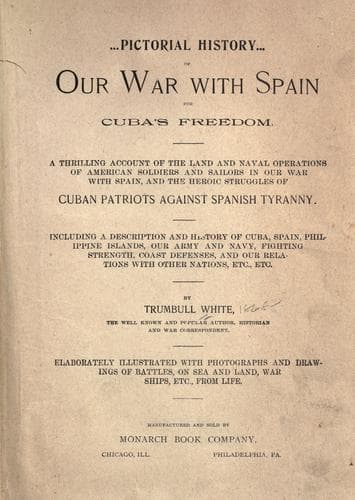
Our War with Spain for Cuba's FreedomWhite, Trumbull
History
Our War with Spain for Cuba's Freedom
White, Trumbull
Cuba -- History; Spain -- Foreign relations -- United States; Spanish-American War, 1898; United States -- Foreign relations -- Spain
The harbor of San Juan is the chief in Puerto Rico, and one of the
best of its size in the Caribbean sea. It is safe and sheltered,
large and land-locked, and though the entrance is somewhat "foul,"
ships drawing three fathoms can enter and find anchorage within,
good holding ground being had at any depth up to six fathoms. The
bay is broad as well as beautiful, and opens toward the north, so
that a vessel laying her course from New York could, if there were
no obstructions en route, sail directly into the harbor.
The fortifications which surround the city of San Juan are, like
the Spanish pedigrees, ancient, flamboyant, beautiful to look at,
but as worthless withal. This city of about 25,000 inhabitants is
completely inclosed within imposing walls of stone and hardened
mortar from 50 to 100 feet in height. They have picturesque gates
and drawbridges, portcullises and demilunes, quaint old sentry
boxes projecting into the sea, frowning battlements, and all that;
but most of their cannon date back from the last century.
In ancient times the chief fort or castle was called the "morro," or
Moorish tower, because it was generally round; and San Juan, like
Havana, has its Morro as the most prominent point of its fortifications.
It stands on a bluff jutting out from the city walls and has a
lighthouse immediately in the rear of it. Against the seaward front of
the massive walls the ocean pounds and thunders, but the landward harbor
is quiet and safe for any craft. A broad parade ground is inclosed
within the walls, westward from the citadel, and not far off is the
oldest house in the city, no less a structure than the ancient castle of
Ponce de Leon, one-time governor here and discoverer of Florida. His
ashes are also kept here, in a leaden case, for Ponce the Lion-Hearted
was a great man in his day and cleaned out the Indians of this island
with a thoroughness that earned him an exceeding great reward.
Just under the northern wall of the castle is the public cemetery,
the gate to it overhung by an ornate sentry box, and the bones of
evicted tenants of graves whose terms of rental have expired, are
piled in the corners of the inclosure. The prevailing winds by day
are from the sea landward; by night, from the inland mountains
toward the coast. Far inland rises the conical summit of the great
Luquillo, a mountain about 4,000 feet in height, and from whose
sides descend streams that fertilize the island.
It is about ninety miles from San Juan to Ponce, the southern
port, by a fine road diagonally across the island. The Spaniards
generally are poor road-builders, but in this island they have
done better than in Cuba, and one may travel here with a fair
amount of comfort to the mile. There are several lines of
railroads building, a system being projected around the island 340
miles in length.
Public-domain text, read in full here on John Shaqi.
Reviews
Reviews
No reviews yet
Be the first to share your thoughts on this work.
Elsewhere in the archive
Join the Discussion
Join the discussion
Sign in to leave a comment or review.
Sign InorCreate an account