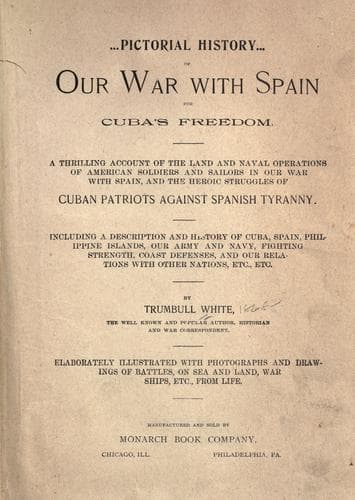
Our War with Spain for Cuba's FreedomWhite, Trumbull
History
Our War with Spain for Cuba's Freedom
White, Trumbull
Cuba -- History; Spain -- Foreign relations -- United States; Spanish-American War, 1898; United States -- Foreign relations -- Spain
The Baron describes with rapture the sabino, so called by the
natives, but by him called the talauma; it is from fifteen to
twenty feet high, with spreading branches, having large silvery
leaves and bearing immense white, odorous flowers. The hietella is
another tree that has remarkable leaves and yields beautiful
crimson flowers. He describes still another tree, without naming
it, as having orangelike foliage, large purple flowers, and as
having in its neighborhood other trees, different from it, but
resembling it and evidently allied to it. This tree, he says, is
not found elsewhere. Still another tree, the ortegon, whose
flowers are purple spikes a yard long, and whose wood is used for
timber, is common on the high lands near the coast. And there are
dye woods, mahogany and lignum vitae. Hence it is seen that the
forests of Puerto Rico are generally beautiful, and strange in
some of their features.
The words Puerto Rico are, when translated, Rich Port, and they
are very applicable to this snug spot in the Atlantic ocean, only
a short distance off the United States coast. Every variety of
soil is adapted to the growth of a particular kind of crop. The
highest hills, as the lowest valleys, are cultivated with
reference to what they will best produce. On the hills, rice; in
the valleys, coffee, cotton and sugar cane; on the rising grounds
between the valleys and hills, tobacco. Puerto Rico rice, unlike
that of the Carolinas, grows on dry lands, even on the highest
hills, without watering. It is the staple food of the laborers.
The consular report to Washington for 1897 says the product of
coffee that year was 26,655 tons; of sugar, 54,205 tons, and of
tobacco, 1,039 tons. The number of bales of cotton is not given,
but the consul expatiates on its fine quality. The richness of the
sugar lands may be judged from this item in the report: "Three
hogsheads of sugar is an average yield per acre, without using
fertilizers of any kind."
Puerto Rico is one of the finest grazing countries in the world.
Its herds of cattle are immense, and from them are supplied cattle
of a superior quality to the other West India islands. Great
quantities of hides are shipped to various countries.
Though richly agricultural as the island is, and entitled as it is
to be regarded as exclusively agricultural, in past times
considerable mining was done there, in gold, copper and salt.
Indeed, copper is still mined to a small extent, and salt is still
so plentiful that the government finds a profit in monopolizing
the sale of it.
Puerto Rico is only 100 miles in length and from fifty to sixty
miles in breadth, and as square as a dry-goods box. East and west
and north and south its coast lines run almost as regularly as if
projected by compass. It is the delight of the sailorman, as its
fertile soil is the joy of the agriculturist.
Public-domain text, read in full here on John Shaqi.
Reviews
Reviews
No reviews yet
Be the first to share your thoughts on this work.
Elsewhere in the archive
Join the Discussion
Join the discussion
Sign in to leave a comment or review.
Sign InorCreate an account