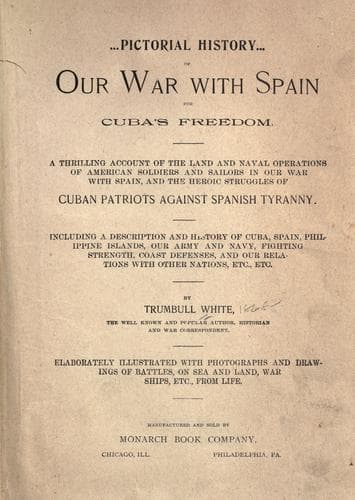
Our War with Spain for Cuba's FreedomWhite, Trumbull
History
Our War with Spain for Cuba's Freedom
White, Trumbull
Cuba -- History; Spain -- Foreign relations -- United States; Spanish-American War, 1898; United States -- Foreign relations -- Spain
Then came fretful days of waiting and not a word further as to the
great battle. To add to the anxiety, from time to time came ugly
rumors about Admiral Dewey being trapped, and when all the
circumstances of the case were considered it is not strange that
something like a chill of apprehension began to be felt as to the
fate of the American fleet and its gallant commander. Manila bay
was known to be mined, and electric connections might again have
been made. The guns of the forts on the land-locked bay might not
have been silenced, and Spanish treachery and guile might have
accomplished what in open battle Spain's fleet had been unable to
do.
But the morning of the 7th of May brought word from Hongkong that
sent a thrill of patriotic pride through all America. Our Yankee
tars had won the fight, and won it without the loss of a man.
Even those who witnessed the overwhelming victory could scarcely
understand how the ships and the men of Admiral Dewey's vessels
came out of the battle unhurt and practically unmarked.
Soon after midnight on Sunday morning, May 1, the American fleet,
led by the flagship Olympia, the largest vessel among them, passed
unnoticed the batteries which were attempting to guard the wide
entrance to the harbor. Each vessel had orders to keep 400 yards
behind the preceding one, and as there were nine vessels,
including the two transports and colliers Nanshan and Zafiro, in
the American fleet, the line was nearly a mile and three-quarters
long, and at the rate of steaming it was perhaps three-quarters of
an hour from the time the Olympia came within range of the shore
batteries until the two transports were safely inside the harbor.
The Olympia, Baltimore, Raleigh, Petrel and Concord passed in
safety and the land batteries might never have suspected the
presence of the fleet but for a peculiar accident on the
McCulloch. The soot in the funnel caught fire. Flames spouted up
from it, and the sparks fell all over the deck. The batteries must
have been awake and watching. Five minutes later, or just at
11:50, signals were seen on the south shore, apparently on
Limbones point. The flying sparks from this boat made her the only
target in the American line. She continued to steam ahead, and at
12:15, May 1, just as she came between the fort at Restingo and
the batteries on the island of Corregidor she was fired upon by
the fort at the south.
Public-domain text, read in full here on John Shaqi.
Reviews
Reviews
No reviews yet
Be the first to share your thoughts on this work.
Elsewhere in the archive
Join the Discussion
Join the discussion
Sign in to leave a comment or review.
Sign InorCreate an account