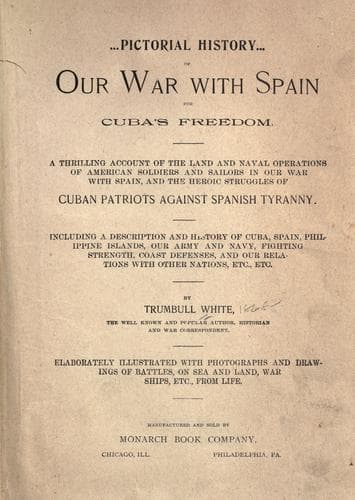
Our War with Spain for Cuba's FreedomWhite, Trumbull
History
Our War with Spain for Cuba's Freedom
White, Trumbull
Cuba -- History; Spain -- Foreign relations -- United States; Spanish-American War, 1898; United States -- Foreign relations -- Spain
The Boston, just ahead, had her guns manned and ready, and she
responded to the shore fire with great promptness, sending an
eight-inch shell toward the curl of smoke seen rising from the
battery. This was the first shot fired by the Americans. It was
not possible to judge of its effect. There was another flash on
shore and a shell went singing past, only a few yards ahead of her
bow. If it had struck fairly it would have ripped up the unarmored
cutter. This was the McCulloch's only chance to get into battle.
She slowed down and stopped and sent a six-pound shot at the shore
battery and followed immediately with another.
The Spaniards answered, but this time the shot went wild. The
McCulloch then sent a third shell, and almost immediately, the
Boston repeated with one of her big guns. After that the shore
battery ceased, and the last half of the fleet steamed into the
bay without further interruption. At no time did the batteries on
Corregidor fire. All the firing by the Spanish came from the south
battery, which was much nearer. Five or six shells were fired by
the Americans, and the Spanish shot three times, doing absolutely
no damage. There were conflicting reports among the naval officers
as to the firing at the entrance to the bay, but it is certain
that the McCulloch fired three shots. During this firing, the
chief engineer of the McCulloch died of nervous shock.
WHEN SPANISH SHIPS WERE SIGHTED.
After passing through the channel the American line moved very
slowly. The men on the McCulloch were in a fighting fever after
the brush at the entrance to the harbor, and were expecting every
minute to hear cannonading from the heavy ships ahead. The fleet
crept on and on, waiting under the cover of darkness, and not
certain as to their location or at all sure that they would not
run into a nest of mines at any moment.
It was nearly 1 o'clock when they were safely in the bay. Between
that hour and 4:30 the fleet, moving slowly in a northeasterly
direction, headed for a point perhaps five miles to the north of
Manila. After covering about seventeen miles, and with the first
light of day, the Spanish ships were sighted off to the east under
shelter of the strongly fortified naval station at Cavite. The
batteries and the town of Cavite are about seven miles southwest
of Manila, and are on an arm of land reaching northward to inclose
a smaller harbor, known as Baker bay. From where the fleet first
stopped, the shapes of the larger Spanish cruisers could be made
out dimly, and also the irregular outlines of the shore batteries
behind. It was evident, even to a landsman, that the Spanish fleet
would not fight unless our vessels made the attack, coming within
range of the Cavite batteries.
Public-domain text, read in full here on John Shaqi.
Reviews
Reviews
No reviews yet
Be the first to share your thoughts on this work.
Elsewhere in the archive
Join the Discussion
Join the discussion
Sign in to leave a comment or review.
Sign InorCreate an account