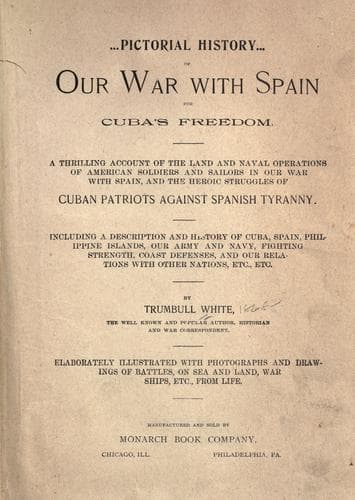
Our War with Spain for Cuba's FreedomWhite, Trumbull
History
Our War with Spain for Cuba's Freedom
White, Trumbull
Cuba -- History; Spain -- Foreign relations -- United States; Spanish-American War, 1898; United States -- Foreign relations -- Spain
Toward the close of the decisive engagement, and just after the
Reina Christina had been sent back, hammered to pieces and set on
fire, two small torpedo boats made a daring attempt to slip up on
the Olympia. A pall of smoke was hanging over the water. Taking
advantage of this, they darted out from the Spanish lines and
headed straight for the American flagship. They were fully 800
yards in advance of the Spanish line (or more than half of the way
toward the Olympia) when they were discovered. Admiral Dewey
signaled his men to concentrate all batteries on them. Every gun
on the port side of the Olympia was leveled on the two little
craft which came flying across the water. A fierce fire was
opened, but they escaped the first volley and came on at full
speed. The flagship stopped. A second broadside was delivered. The
torpedo boats were either injured or else alarmed, for they turned
hastily and started for the shore. An eight-inch shell struck one.
It exploded and sunk immediately, with all on board. The other,
which had been hit, ran all the way to shore and was beached.
These were the only two attempts the Spanish made to offer
offensive battle.
It would be difficult to describe in detail these first two hours
of terrific fighting. The sounds were deafening, and at times the
smoke obscured almost the whole picture of battle. The American
commander himself could not estimate the injury to the enemy until
after he had withdrawn from the first general engagement and
allowed the smoke to clear away. Unfortunately, our fleet had no
supply of smokeless powder. All during the fighting of Sunday
morning, Admiral Dewey stood with Captain Lambertson on the
forward bridge of the Olympia. He was absolutely exposed to the
heaviest firing, because the Spanish fleet and the land batteries
as well continually made a target of our big flagship. Captain
Wildes, on the Boston, carried a fan as he stood on the bridge,
and at one time drank a cup of coffee while continuing to give
orders to his gunners.
It was 7:45 when the American fleet withdrew out of range, not
because it had suffered any reverses, but merely to ascertain the
damages and hold a consultation.
Public-domain text, read in full here on John Shaqi.
Reviews
Reviews
No reviews yet
Be the first to share your thoughts on this work.
Elsewhere in the archive
Join the Discussion
Join the discussion
Sign in to leave a comment or review.
Sign InorCreate an account