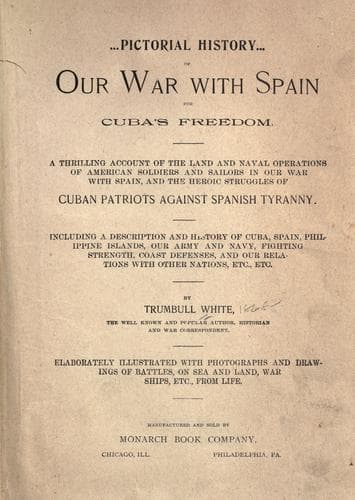
Our War with Spain for Cuba's FreedomWhite, Trumbull
History
Our War with Spain for Cuba's Freedom
White, Trumbull
Cuba -- History; Spain -- Foreign relations -- United States; Spanish-American War, 1898; United States -- Foreign relations -- Spain
Not until the commanders had reported to Admiral Dewey did he
learn of the insignificant loss which his fleet had sustained. Not
one man had been killed and not one vessel was so badly injured
but that it was ready to put to sea at once. Through the glasses
it could be seen that the Reina Christina and the Castilla were
burning. The smaller vessels had taken refuge behind the arsenal
at Cavite. The Mindanao had been driven ashore. Already the
victory was almost complete. The American sailors were wild with
enthusiasm. Although hardly one of them had slept the night
before, and they had been fighting in a burning temperature, they
were more than anxious to return to the engagement and finish the
good work. It was thought best, however, to take a rest for at
least three hours. The decks were cleaned and the guns readjusted,
and after food had been served to the men, the fleet formed and
headed straight for Cavite again. The remnant of the Spanish
squadron offered very little resistance, but the forts at Cavite
continued their wild efforts to strike an American warship.
MAKING THE SECOND ATTACK.
This time the Baltimore was sent in advance. She headed boldly to
within range of the Cavite batteries. By this time the Americans
had a contempt for Spanish marksmanship. The Baltimore opened fire
and pounded away for thirty minutes. At the end of that time every
gun of the batteries had been silenced. Of the Spanish war-ships
the Antonio de Ulloa was the only one which came out of refuge to
offer battle with the Baltimore and she met with horrible
punishment. Her decks were literally swept with shell, but even
after she was apparently wrecked her lower guns were used with
wonderful persistence.
The Baltimore, having silenced the forts, turned all her guns on
the Spanish cruiser and actually riddled her. She sank and all her
crew went down with her. That was the end of Spanish resistance.
Admiral Dewey ordered his light-draught vessels to enter the navy
yard and destroy everything that might give future trouble. The
Boston, the Concord and the Petrel were detailed for this duty,
but the Boston, drawing twenty feet, ran aground twice, not
knowing the shoals, and had to leave the work to the Petrel and
Concord. By the time these two vessels reached the navy yard they
found the vessels there abandoned and most of them on fire. They
destroyed the fag end of the Spanish fleet, and when Sunday
afternoon came there was nothing left above water to represent the
Spanish naval force in Asiatic waters except the transport Manila.
The arsenal had been shelled to pieces.
Public-domain text, read in full here on John Shaqi.
Reviews
Reviews
No reviews yet
Be the first to share your thoughts on this work.
Elsewhere in the archive
Join the Discussion
Join the discussion
Sign in to leave a comment or review.
Sign InorCreate an account