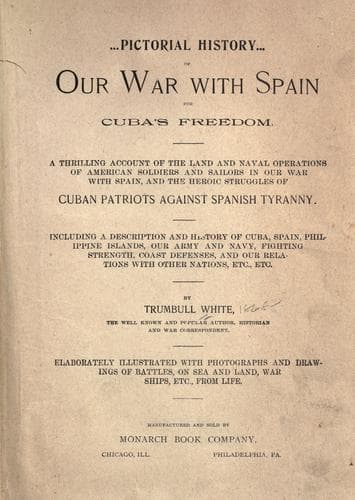
Our War with Spain for Cuba's FreedomWhite, Trumbull
History
Our War with Spain for Cuba's Freedom
White, Trumbull
Cuba -- History; Spain -- Foreign relations -- United States; Spanish-American War, 1898; United States -- Foreign relations -- Spain
At 12:45 o'clock the signal was given that the Spanish had
surrendered. The word was passed rapidly from ship to ship. The
American sailors were crazy with delight. There was tremendous
cheering on every ship. The enthusiasm became even greater when
the word was passed that not one of our men had been killed and
not one American vessel had been injured. The eight men who were
hurt by the explosion on the Baltimore continued to fight until
the end of the battle. The Boston was struck once and the
officers' quarters set on fire.
For some reason the Spanish gunners seemed to think that the
Baltimore was especially dangerous, having the general build of a
battleship, and, next to the flagship, she had to withstand the
greatest amount of firing, and was struck several times, with no
great damage. Except for the torn rigging and a few dents here and
there few signs could be discovered that the vessels had engaged
in one of the most decisive naval battles of modern times.
The Concord and the Petrel were not hit at all, although the
latter went deeper into the enemy's position than any other vessel
in our fleet The Olympia made a glorious record. She was struck
thirteen times, counting the shells which tore through her
rigging, but she came out as good as she went in.
LOSS OF THE SPANISH.
Compared with these trivial losses the damage done to the Spanish
was fearful. Five hundred and fifty of them were killed and 625
wounded. Eleven of their ships were totally demolished, and the
Americans captured one transport and several smaller vessels.
Their money loss by reason of the battle was not less than
$5,000,000.
During the naval action a battery of 10-inch guns at Manila opened
an ineffectual fire on our fleet as it was moving into action
north of Cavite. The admiral did not return' the fire out of mercy
for the people of Manila, as any shots passing over the shore
batteries would have landed in a populous portion of the city.
On Monday, May 2, the Raleigh and Baltimore were sent to demand
the surrender of the forts at the mouth of the bay. These forts
were taken without resistance. The troops had fled and only the
commandant remained to surrender himself.
In regard to the cutting of the cable, Admiral Dewey regarded the
action as necessary. He sent word to the governor by the British
consul that if he was permitted to send his dispatches to the
United States government the cable would not be cut. The governor
refused to promise and Admiral Dewey decided to stop all
communication between Manila and Madrid.
Public-domain text, read in full here on John Shaqi.
Reviews
Reviews
No reviews yet
Be the first to share your thoughts on this work.
Elsewhere in the archive
Join the Discussion
Join the discussion
Sign in to leave a comment or review.
Sign InorCreate an account