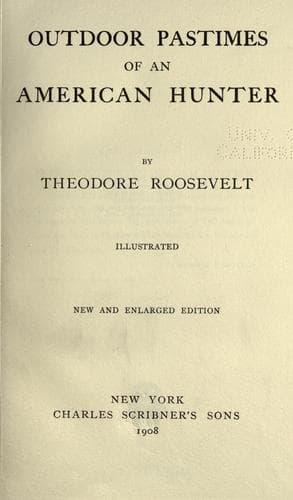
Outdoor pastimes of an American hunterRoosevelt, Theodore
General
Outdoor pastimes of an American hunter
Roosevelt, Theodore
Hunting -- United States; Hunting -- West (U.S.)
When the shadows had lengthened, but before any coolness had come into
the air, I would head for the appointed camping-place. Sometimes this
would be on the brink of some desolate little pool under a low, treeless
butte, or out on the open prairie where the only wood was what we had
brought with us. At other times I would find the wagon drawn up on the
edge of some shrunken plains river, under a line of great cottonwoods
with splintered branches and glossy leaves that rustled all day long.
Such a camp was always comfortable, for there was an abundance of wood
for the fire, plenty of water, and thick feed in which the horses
grazed—one or two being picketed and the others feeding loose until
night came on. If I had killed a prongbuck, steaks were speedily
sizzling in the frying-pan over the hot coals. If I had failed to get
anything, I would often walk a mile or two down or up the river to see
if I could not kill a couple of prairie-chickens or ducks. If the
evening was at all cool, we built a fire as darkness fell, and sat
around it, while the leaping flames lit up the trunks of the cottonwoods
and gleamed on the pools of water in the half-dry river bed. Then I
would wrap myself in my blanket and lie looking up at the brilliant
stars until I fell asleep.
In both 1893 and 1894 I made trips to a vast tract of rolling prairie
land, some fifty miles from my ranch, where I had for many years enjoyed
the keen pleasure of hunting the prongbuck. In 1893 the prong-horned
bands were as plentiful in this district as I have ever seen them
anywhere. Lambert was with me; and in a week’s trip, including the
journey out and back, we easily shot all the antelope we felt we had any
right to kill; for we only shot to get meat, or an unusually fine head.
Lambert did most of the shooting; and I have never seen a professional
hunter do better in stalking antelope on the open prairie. I myself
fired at only two antelope, both of which had already been missed. In
each case a hard run and much firing at long ranges, together with in
one case some skilful manœuvring, got me my game; yet one buck cost ten
cartridges and the other eight. In 1894 I had exactly the reverse
experience. I killed five antelope for thirty-six shots, but each one
that I killed was killed with the first bullet, and in not one case
where I missed the first time did I hit with any subsequent shot. These
five antelope were killed at an average distance of about 150 yards.
Those that I missed were, of course, much farther off on an average, and
I usually emptied my magazine at each. The number of cartridges spent
would seem extraordinary to a tyro; and an unusually skilful shot, or
else a very timid shot who fears to take risks, will of course make a
better showing per head killed; but I doubt if men with experience in
antelope hunting, who keep an accurate account of the cartridges they
expend, will see anything much out of the way in the performance.
Public-domain text, read in full here on John Shaqi.
Reviews
Reviews
No reviews yet
Be the first to share your thoughts on this work.
Elsewhere in the archive
Join the Discussion
Join the discussion
Sign in to leave a comment or review.
Sign InorCreate an account