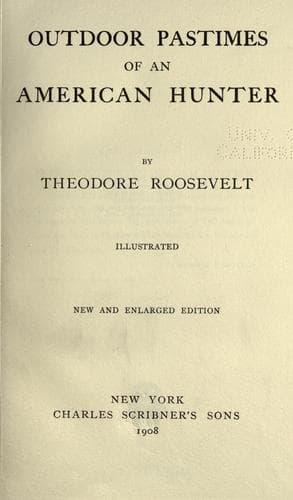
Outdoor pastimes of an American hunterRoosevelt, Theodore
General
Outdoor pastimes of an American hunter
Roosevelt, Theodore
Hunting -- United States; Hunting -- West (U.S.)
During the years I have hunted in the West I have always, where
possible, kept a record of the number of cartridges expended for every
head of game killed, and of the distances at which it was shot. I have
found that with bison, bear, moose, elk, caribou, bighorn and white
goat, where the animals shot at were mostly of large size and usually
stationary, and where the mountainous or wooded country gave chance for
a close approach, the average distance at which I have killed the game
has been eighty yards, and the average number of cartridges expended per
head slain, three; one of these representing the death-shot, and the
others standing either for misses outright, of which there were not
many, or else for wounding game which escaped, or which I afterward
overtook, or for stopping cripples or charging beasts. I have killed but
two peccaries, using but one cartridge for each; they were close up. My
experiences with cougar have already been narrated. At wolves and
coyotes I have generally had to take running shots at very long range,
and I have shot but two—one of each—for fifty cartridges. Blacktail deer
I have generally shot at about ninety yards, at an expenditure of about
four cartridges apiece. Whitetail I have killed at shorter range; but
the shots were generally running, often taken under difficult
circumstances, so that my expenditure of cartridges was rather larger.
Antelope, on the other hand, I have on the average shot at a little
short of 150 yards, and they have cost me about nine cartridges apiece.
This, of course, as I have explained above, does not mean that I have
missed eight out of nine antelope, for often the entire nine cartridges
would be spent at an antelope which I eventually got. It merely means
that, counting all the shots of every description fired at antelope, I
had one head to show for each nine cartridges expended.
Thus, the first antelope I shot in 1893 cost me ten cartridges, of which
three hit him, while the seven that missed were fired at over 400 yards’
distance while he was running. We saw him while we were with the wagon.
As we had many miles to go before sunset, we cared nothing about
frightening other game, and, as we had no fresh meat, it was worth while
to take some chances to procure it. When I first fired, the prongbuck
had already been shot at and was in full flight. He was beyond all
reasonable range, but some of our bullets went over him and he began to
turn. By running to one side I got a shot at him at a little over 400
paces, as he slowed to a walk, bewildered by the firing, and the bullet
broke his hip. I missed him two or three times as he plunged off, and
then by hard running down a watercourse got a shot at 180 paces and
broke his shoulder, and broke his neck with another bullet when I came
up.
Public-domain text, read in full here on John Shaqi.
Reviews
Reviews
No reviews yet
Be the first to share your thoughts on this work.
Elsewhere in the archive
Join the Discussion
Join the discussion
Sign in to leave a comment or review.
Sign InorCreate an account