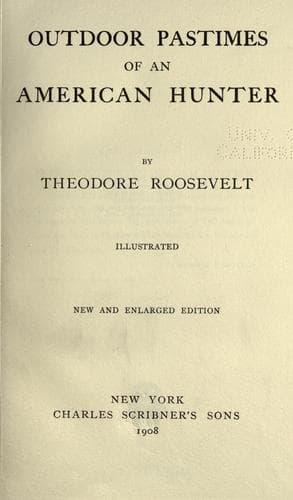
Outdoor pastimes of an American hunterRoosevelt, Theodore
General
Outdoor pastimes of an American hunter
Roosevelt, Theodore
Hunting -- United States; Hunting -- West (U.S.)
watching my movements, call, “By George, he’s missed! I saw the bullet
strike the cliff.” I had fired behind the shoulders, and the bullet,
going through, had buried itself in the bluff beyond. The wound was
almost instantaneously fatal, and the sheep, after striving in vain to
keep its balance, fell heels over head down a crevice, where it jammed.
I descended, released the carcass, and pitched it on ahead of me, only
to have it jam again near the foot of the cliff. Before I got it loose I
was joined by my three companions, who had been running headlong toward
me through the brush ever since the time they had seen the animal fall.
I never obtained another sheep under circumstances which seemed to me
quite so remarkable as these; for sheep are, on the whole, the wariest
of game. Nevertheless, with all game there is an immense amount of
chance in the chase, and it is perhaps not wholly uncharacteristic of a
hunter’s luck that, after having hunted faithfully in vain and with much
hard labor for several days through a good sheep country, we should at
last have obtained one within sight and earshot of camp. Incidentally I
may mention that I have never tasted better mutton, or meat of any kind,
than that furnished by this tender yearling.
The nomenclature and exact specific relationships of American sheep,
deer and antelope offer difficulties not only to the hunter but to the
naturalist. As regards the nomenclature, we share the trouble
encountered by all peoples of European descent who have gone into
strange lands. The incomers are almost invariably men who are not
accustomed to scientific precision of expression. Like other people,
they do not like to invent names if they can by any possibility make use
of those already in existence, and so in a large number of cases they
call the new birds and animals by names applied to entirely different
birds and animals of the Old World to which, in the eyes of the
settlers, they bear some resemblance. In South America the Spaniards,
for instance, christened “lion” and “tiger” the great cats which are
properly known as cougar and jaguar. In South Africa the Dutch settlers,
who came from a land where all big game had long been exterminated, gave
fairly grotesque names to the great antelopes, calling them after the
European elk, stag, and chamois. The French did but little better in
Canada. Even in Ceylon the English, although belonging for the most part
to the educated classes, did no better than the ordinary pioneer
settlers, miscalling the sambur stag an elk, and the leopard a cheetah.
Our own pioneers behaved in the same way. Hence it is that we have no
distinctive name at all for the group of peculiarly American game birds
of which the bobwhite is the typical representative; and that, when we
could not use the words quail, partridge, or pheasant, we went for our
terminology to the barn-yard, and called our fine grouse, fool-hens,
sage-hens, and prairie-chickens. The bear and wolf our people recognized
Public-domain text, read in full here on John Shaqi.
Reviews
Reviews
No reviews yet
Be the first to share your thoughts on this work.
Elsewhere in the archive
Join the Discussion
Join the discussion
Sign in to leave a comment or review.
Sign InorCreate an account