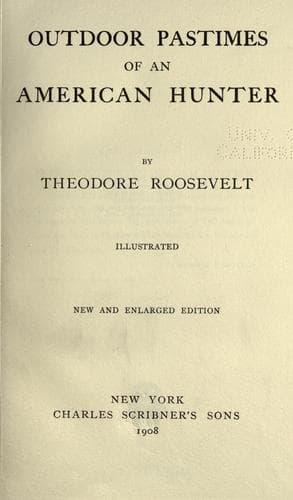
Outdoor pastimes of an American hunterRoosevelt, Theodore
General
Outdoor pastimes of an American hunter
Roosevelt, Theodore
Hunting -- United States; Hunting -- West (U.S.)
at once. The bison they called a buffalo, which was no worse than the
way in which in Europe the Old World bison was called an aurochs. The
American true elk and reindeer were rechristened moose and
caribou—excellent names, by the way, derived from the Indian. The huge
stag was called an elk. The extraordinary antelope of the high Western
peaks was christened the white goat; not unnaturally, as it has a most
goatlike look. The prongbuck of the plains, an animal standing entirely
alone among ruminants, was simply called antelope. Even when we invented
names for ourselves, we applied them loosely. The ordinary deer is
sometimes known as the red deer, sometimes as the Virginia deer, and
sometimes as the whitetail deer—the last being by far the best and most
distinctive term.
In the present condition of zoological research it is not possible to
state accurately how many “species” of deer and sheep there are in North
America, both because mammalogists have not at hand a sufficient amount
of material in the way of large series of specimens from different
localities, and because they are not agreed among themselves as to the
value of “species,” or indeed as to exactly what is denoted by the term.
Of course, if we had a complete series of specimens of extinct and
fossil deer before us, there would be a perfect intergradation among all
the existing forms through their long-vanished ancestral types, as the
existing gaps have been created by the extinction and transformation of
those former types. Where the gap is very broad and well marked no
difficulty exists in using terms which shall express the difference.
Thus the gap separating the moose, the caribou, and the wapiti from one
another, and from the smaller American deer, is so wide, and there is so
complete a lack of transitional forms, that the differences among them
are expressed by naturalists by the use of different generic terms. The
gap between the whitetail and the different forms of blacktail, though
much less, is also clearly marked. But when we come to consider the
blacktail among themselves, we find two very distinct types which yet
show a certain tendency to intergrade; and with the whitetail very wide
differences exist, even in the United States, both individually among
the deer of certain localities, and also as between all the deer of one
locality when compared with all the deer of another. Our present
knowledge of the various forms hardly justifies us in dogmatizing as to
their exact relative worth; and even if our knowledge was more complete,
naturalists are as yet wholly at variance as to the laws which should
govern specific nomenclature. However, the hunter, the mere field
naturalist, and the lover of outdoor life, are only secondarily
interested in the niceness of these distinctions.
Public-domain text, read in full here on John Shaqi.
Reviews
Reviews
No reviews yet
Be the first to share your thoughts on this work.
Elsewhere in the archive
Join the Discussion
Join the discussion
Sign in to leave a comment or review.
Sign InorCreate an account