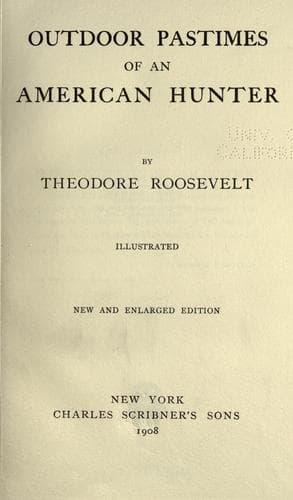
Outdoor pastimes of an American hunterRoosevelt, Theodore
General
Outdoor pastimes of an American hunter
Roosevelt, Theodore
Hunting -- United States; Hunting -- West (U.S.)
In addition to being a true sportsman and not a game butcher, in
addition to being a humane man as well as keen-eyed, strong-limbed, and
stout-hearted, the big game hunter should be a field naturalist. If
possible, he should be an adept with the camera; and hunting with the
camera will tax his skill far more than hunting with the rifle, while
the results in the long run give much greater satisfaction. Wherever
possible he should keep a note-book, and should carefully study and
record the habits of the wild creatures, especially when in some remote
regions to which trained scientific observers but rarely have access. If
we could only produce a hunter who would do for American big game what
John Burroughs has done for the smaller wild life of hedgerow and
orchard, farm and garden and grove, we should indeed be fortunate. Yet
even though a man does not possess the literary faculty and the powers
of trained observation necessary for such a task, he can do his part
toward adding to our information by keeping careful notes of all the
important facts which he comes across. Such note-books would show the
changed habits of game with the changed seasons, their abundance at
different times and different places, the melancholy data of their
disappearance, the pleasanter facts as to their change of habits which
enable them to continue to exist in the land, and, in short, all their
traits. A real and lasting service would thereby be rendered not only to
naturalists, but to all who care for nature.
Along the Little Missouri there have been several curious changes in the
fauna within my own knowledge. Thus magpies have greatly decreased in
numbers. This is, I believe, owing to the wolf hunters, for magpies
often come around carcasses and pick up poisoned baits. I have seen as
many as seven lying dead around a bait. They are much less plentiful
than they formerly were. In 1894 I was rather surprised at meeting a
porcupine, usually a beast of the timber, at least twenty miles from
trees. He was grubbing after sage-brush roots on the edge of a cut bank
by a half-dried creek. I was stalking an antelope at the time, and
stopped to watch him for about five minutes. He paid no heed to me,
though I was within three or four paces of him. Porcupines are easily
exterminated; and they have diminished in numbers in this neighborhood.
Both the lucivee, or northern lynx, and the wolverene have been found on
the Little Missouri, near the Kildeer Mountains, but I do not know of a
specimen of either that has been killed there for some years past.
Bobcats are still not uncommon. The blackfooted ferret was always rare,
and is rare now. But few beaver are left; they were very abundant in
1880, but were speedily trapped out when the Indians vanished and the
Northern Pacific Railroad was built. While this railroad was building,
the beaver frequently caused much trouble by industriously damming the
culverts.
Public-domain text, read in full here on John Shaqi.
Reviews
Reviews
No reviews yet
Be the first to share your thoughts on this work.
Elsewhere in the archive
Join the Discussion
Join the discussion
Sign in to leave a comment or review.
Sign InorCreate an account