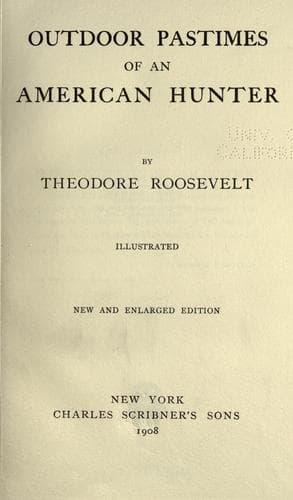
Outdoor pastimes of an American hunterRoosevelt, Theodore
General
Outdoor pastimes of an American hunter
Roosevelt, Theodore
Hunting -- United States; Hunting -- West (U.S.)
The bear were all holed up for the winter, and so our game was limited
to cougars and bobcats. In the books the bobcat is always called a lynx,
which it of course is; but whenever a hunter or trapper speaks of a lynx
(which he usually calls “link,” feeling dimly that the other
pronunciation is a plural), he means a lucivee. Bobcat is a good
distinctive name, and it is one which I think the book people might with
advantage adopt; for wildcat, which is the name given to the small lynx
in the East, is already pre-empted by the true wildcat of Europe. Like
all people of European descent who have gone into strange lands, we
Americans have christened our wild beasts with a fine disregard for
their specific and generic relations. We called the bison “buffalo” as
long as it existed, and we still call the big stag an “elk,” instead of
using for it the excellent term wapiti; on the other hand, to the true
elk and the reindeer we gave the new names moose and caribou—excellent
names, too, by the way. The prong buck is always called antelope, though
it is not an antelope at all; and the white goat is not a goat; while
the distinctive name of “bighorn” is rarely used for the mountain sheep.
In most cases, however, it is mere pedantry to try to upset popular
custom in such matters; and where, as with the bobcat, a perfectly good
name is taken, it would be better for scientific men to adopt it. I may
add that in this particular of nomenclature we are no worse sinners than
other people. The English in Ceylon, the English and Dutch in South
Africa, and the Spanish in South America, have all shown the same genius
for misnaming beasts and birds.
[Illustration:
TURK AND A BOBCAT IN TOP OF A PINYON
From a photograph by Philip B. Stewart
]
Bobcats were very numerous where we were hunting. They fed chiefly upon
the rabbits, which fairly swarmed; mostly cotton-tails, but a few jacks.
Contrary to the popular belief, the winter is in many places a time of
plenty for carnivorous wild beasts. In this place, for instance, the
abundance of deer and rabbits made good hunting for both cougar and
bobcat, and all those we killed were as fat as possible, and in
consequence weighed more than their inches promised. The bobcats are
very fond of prairie-dogs, and haunt the dog towns as soon as spring
comes and the inhabitants emerge from their hibernation. They sometimes
pounce on higher game. We came upon an eight months’ fawn—very nearly a
yearling—which had been killed by a big male bobcat; and Judge Foreman
informed me that near his ranch, a few years previously, an
exceptionally large bobcat had killed a yearling doe. Bobcats will also
take lambs and young pigs, and if the chance occurs will readily seize
their small kinsman, the house cat.
Public-domain text, read in full here on John Shaqi.
Reviews
Reviews
No reviews yet
Be the first to share your thoughts on this work.
Join the Discussion
Join the discussion
Sign in to leave a comment or review.
Sign InorCreate an account