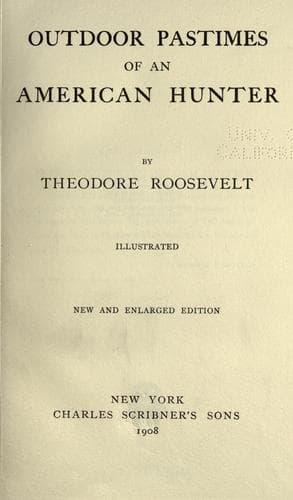
Outdoor pastimes of an American hunterRoosevelt, Theodore
General
Outdoor pastimes of an American hunter
Roosevelt, Theodore
Hunting -- United States; Hunting -- West (U.S.)
At the beginning of the rut the does flee from the bucks, which follow
them by scent at full speed. The whitetail buck rarely tries to form a
herd of does, though he will sometimes gather two or three. The mere
fact that his tactics necessitate a long and arduous chase after each
individual doe prevents his organizing herds as the wapiti bull does.
Sometimes two or three bucks will be found strung out one behind the
other, following the same doe. The bucks wage desperate battle among
themselves during this season, coming together with a clash, and then
pushing and straining for an hour or two at a time, with their mouths
open, until the weakest gives way. As soon as one abandons the fight he
flees with all possible speed, and usually escapes unscathed. While head
to head there is no opportunity for a disabling thrust, but if, in the
effort to retreat, the beaten buck gets caught, he may be killed. Owing
to the character of the antlers, whitetail bucks are peculiarly apt to
get them interlocked in such a fight, and if the efforts of the two
beasts fail to disentangle them, both ultimately perish by starvation. I
have several times come across a pair of skulls with interlocked
antlers. The same thing occurs, though far less frequently, to the
mule-deer and even the wapiti.
The whitetail is the most beautiful and graceful of all our game animals
when in motion. I have never been able to agree with Judge Caton that
the mule-deer is clumsy and awkward in his gait. I suppose all such
terms are relative. Compared to the moose or caribou the mule-deer is
light and quick in his movements, and to me there is something very
attractive in the poise and power with which one of the great bucks
bounds off, all four legs striking the earth together and shooting the
body upward and forward as if they were steel springs. But there can be
no question as to the infinitely superior grace and beauty of the
whitetail when he either trots or runs. The mule-deer and blacktail
bound, as already described. The prongbuck gallops with an even gait,
and so does the bighorn, when it happens to be caught on a flat; but the
whitetail moves with an indescribable spring and buoyancy. If surprised
close up, and much terrified, it simply runs away as hard as it can, at
a gait not materially different from that of any other game animal under
like circumstances, while its head is thrust forward and held down, and
the tail is raised perpendicularly. But normally its mode of
progression, whether it trots or gallops, is entirely unique. In
trotting, the head and tail are both held erect, and the animal throws
out its legs with a singularly proud and free motion, bringing the feet
well up, while at every step there is an indescribable spring. In the
canter or gallop the head and tail are also held erect, the flashing
white brush being very conspicuous. Three or four low, long,
marvellously springy bounds are taken, and then a great leap is made
Public-domain text, read in full here on John Shaqi.
Reviews
Reviews
No reviews yet
Be the first to share your thoughts on this work.
Elsewhere in the archive
Join the Discussion
Join the discussion
Sign in to leave a comment or review.
Sign InorCreate an account