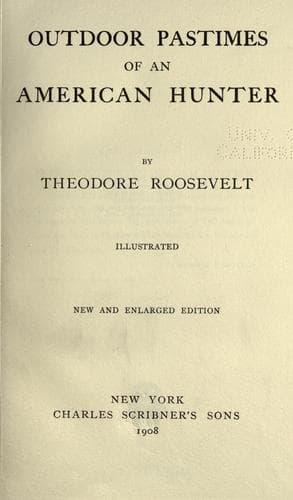
Outdoor pastimes of an American hunterRoosevelt, Theodore
General
Outdoor pastimes of an American hunter
Roosevelt, Theodore
Hunting -- United States; Hunting -- West (U.S.)
high in the air, which is succeeded by three or four low bounds, and
then by another high leap. A whitetail going through the brush in this
manner is a singularly beautiful sight. It has been my experience that
they are not usually very much frightened by an ordinary slow
track-hound, and I have seen a buck play along in front of one,
alternately trotting and cantering, head and flag up, and evidently
feeling very little fear.
To my mind the chase of the whitetail, as it must usually be carried on,
offers less attraction than the chase of any other kind of our large
game. But this is a mere matter of taste, and such men as Judge Caton
and Mr. George Bird Grinnell have placed it above all others as a game
animal. Personally I feel that the chase of any animal has in it two
chief elements of attraction. The first is the chance given to be in the
wilderness; to see the sights and hear the sounds of wild nature. The
second is the demand made by the particular kind of chase upon the
qualities of manliness and hardihood. As regards the first, some kinds
of game, of course, lead the hunter into particularly remote and wild
localities; and the farther one gets into the wilderness, the greater is
the attraction of its lonely freedom. Yet to camp out at all implies
some measure of this delight. The keen, fresh air, the breath of the
pine forests, the glassy stillness of the lake at sunset, the glory of
sunrise among the mountains, the shimmer of the endless prairies, the
ceaseless rustle of the cottonwood leaves where the wagon is drawn up on
the low bluff of the shrunken river—all these appeal intensely to any
man, no matter what may be the game he happens to be following. But
there is a wide variation, and indeed contrast, in the qualities called
for in the chase itself, according as one quarry or another is sought.
The qualities that make a good soldier are, in large part, the qualities
that make a good hunter. Most important of all is the ability to shift
for one’s self, the mixture of hardihood and resourcefulness which
enables a man to tramp all day in the right direction, and, when night
comes, to make the best of whatever opportunities for shelter and warmth
may be at hand. Skill in the use of the rifle is another trait;
quickness in seeing game, another; ability to take advantage of cover,
yet another; while patience, endurance, keenness of observation,
resolution, good nerves, and instant readiness in an emergency, are all
indispensable to a really good hunter.
Public-domain text, read in full here on John Shaqi.
Reviews
Reviews
No reviews yet
Be the first to share your thoughts on this work.
Elsewhere in the archive
Join the Discussion
Join the discussion
Sign in to leave a comment or review.
Sign InorCreate an account