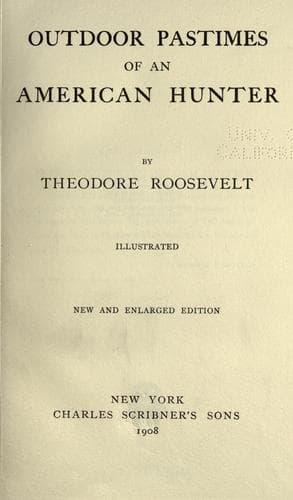
Outdoor pastimes of an American hunterRoosevelt, Theodore
General
Outdoor pastimes of an American hunter
Roosevelt, Theodore
Hunting -- United States; Hunting -- West (U.S.)
In northwestern Colorado the conditions are entirely different.
Throughout this region there are no whitetail and never have been,
although in the winter range of the mule-deer there are a few prongbuck;
and the wapiti once abounded. The mule-deer are still plentiful. They
make a complete migration summer and winter, so that in neither season
is a single individual to be found in the haunts they frequent during
the other season. In the summer they live and bring forth their young
high up in the main chain of the mountains, in a beautiful country of
northern forest growth, dotted with trout-filled brooks and clear lakes.
The snowfall is so deep in these wooded mountains that the deer would
run great risk of perishing if they stayed therein, and indeed could
only winter there at all in very small numbers. Accordingly, when the
storms begin in the fall, usually about the first of October, just
before the rut, the deer assemble in bands and move west and south to
the lower, drier country, where the rugged hills are here and there
clothed with an open growth of pinyon and cedar, instead of the tall
spruces and pines of the summer range. The migrating bands follow one
another along definite trails over mountains, through passes and
valleys, and across streams; and their winter range swarms with them a
few days after the forerunners have put in their appearance in what has
been, during the summer, an absolutely deerless country.
In January and February, 1901, I spent five weeks north of the White
River, in northwestern Colorado. It was in the heart of the wintering
ground of the great Colorado mule-deer herd. Forty miles away to the
east, extending north, lay the high mountains in which these deer had
spent the summer. The winter range, in which I was at the time hunting
cougars, is a region of comparatively light snowfall, though the cold is
bitter. On several occasions during my stay the thermometer went down to
twenty degrees below zero. The hills, or low mountains, for it was
difficult to know which to call them, were steep and broken, and
separated by narrow flats covered with sage-brush. The ordinary trees
were the pinyon and cedar, which were scattered in rather open groves
over the mountain-sides and the spurs between the ravines. There were
also patches of quaking asp, scrub-oak, and brush. The entire country
was thinly covered with ranches, and there were huge pastures enclosed
by wire fences. I have never seen the mule-deer so numerous anywhere as
they were in this country at this time; although in 1883, on the Little
Missouri, they were almost as plentiful. There was not a day we did not
see scores, and on some days we saw hundreds. Frequently they were found
in small parties of two or three, or a dozen individuals, but on
occasions we saw bands of thirty or forty. Only rarely were they found
singly. The fawns were of course well grown, being eight or nine months
old, and long out of the spotted coat. They were still accompanying
Public-domain text, read in full here on John Shaqi.
Reviews
Reviews
No reviews yet
Be the first to share your thoughts on this work.
Elsewhere in the archive
Join the Discussion
Join the discussion
Sign in to leave a comment or review.
Sign InorCreate an account