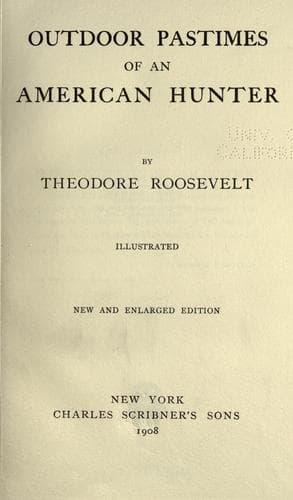
Outdoor pastimes of an American hunterRoosevelt, Theodore
General
Outdoor pastimes of an American hunter
Roosevelt, Theodore
Hunting -- United States; Hunting -- West (U.S.)
their mothers. Ordinarily a herd would consist of does, fawns, and
yearlings, the latter carrying their first antlers. But it was not
possible to lay down a universal rule. Again and again I saw herds in
which there were one or two full-grown bucks associating with the
females and younger deer. At other times we came across small bands of
full-grown bucks by themselves, and occasionally a solitary buck.
Considering the extent to which these deer must have been persecuted, I
did not think them shy. We were hunting on horseback, and had hounds
with us, so we made no especial attempt to avoid noise. Yet very
frequently we would come close on the deer before they took alarm; and
even when alarmed they would sometimes trot slowly off, halting and
looking back. On one occasion, in some bad lands, we came upon four
bucks which had been sunning themselves on the face of a clay wall. They
jumped up and went off one at a time, very slowly, passing diagonally by
us, certainly not over seventy yards off. All four could have been shot
without effort, and as they had fine antlers I should certainly have
killed one, had it been the open season.
When we came on these Colorado mule-deer suddenly, they generally
behaved exactly as their brethren used to in the old days on the Little
Missouri; that is, they would run off at a good speed for a hundred
yards or so, then slow up, halt, gaze inquisitively at us for some
seconds, and again take to flight. While the sun was strong they liked
to lie out in the low brush on slopes where they would get the full
benefit of the heat. During the heavy snow-storms they usually retreated
into some ravine where the trees grew thicker than usual, not stirring
until the weight of the storm was over. Most of the night, especially if
it was moonlight, they fed; but they were not at all regular about this.
I frequently saw them standing up and grazing, or more rarely browsing,
in the middle of the day, and in the late afternoon they often came down
to graze on the flats within view of the different ranch houses where I
happened to stop. The hours for feeding and resting, however, always
vary accordingly as the deer are or are not persecuted. In wild
localities I have again and again found these deer grazing at all hours
of the day, and coming to water at high noon; whereas, where they have
been much persecuted, they only begin to feed after dusk, and come to
water after dark. Of course during this winter weather they could get no
water, snow supplying its place.
Public-domain text, read in full here on John Shaqi.
Reviews
Reviews
No reviews yet
Be the first to share your thoughts on this work.
Elsewhere in the archive
Join the Discussion
Join the discussion
Sign in to leave a comment or review.
Sign InorCreate an account